
Down 14% from 2022, with online channels also posting double-digit negative growth
Online channel share climbs steadily to 49.2%
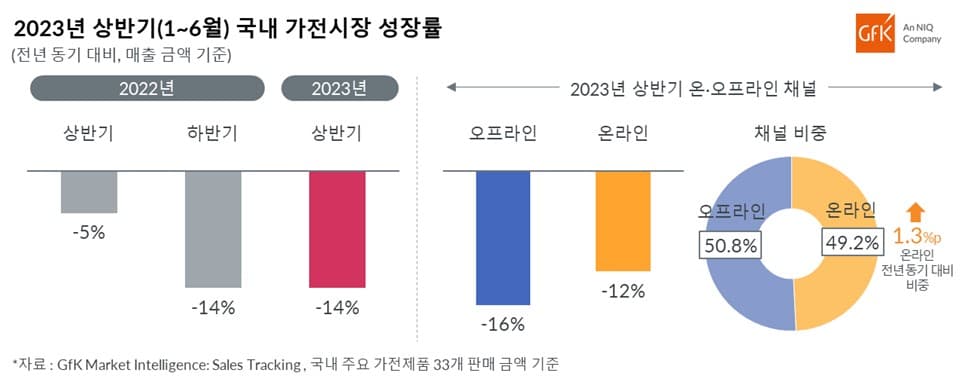
Global market intelligence firm GfK announced that the growth rate of Korea's home appliance market in the first half of 2023 was -14% (based on sales value) compared with the first half of 2022, reflecting a decline in sales volume. This figure is based on the sales value of 33 of Korea's leading home appliance products and covers major offline and online channels.
As a result, Korea's home appliance market once again recorded a double-digit rate of decline following the second half of 2022. This is attributed to home appliance demand — which had risen sharply during the COVID-19 period — returning to pre-pandemic levels alongside the endemic phase, while at the same time consumers with reduced disposable income due to inflation, high interest rates, and the recovery of travel demand cut back on their spending on home appliances.
The online channel offers a clear illustration of the market downturn that continued into 2023. Sales of home appliances through online channels — which had held up relatively well amid the 2022 market decline, with a comparatively low rate of decline that left market size largely intact — fell 12% in the first half of 2023 compared with the first half of 2022. With both online and offline growth rates declining in the double digits, the data reflect a contraction in home appliance demand that has spread across the market as a whole.
However, offline channel sales fell more steeply, dropping 16%, so the online channel's share of the overall home appliance market rose 1.3 percentage points, from 47.9% in the first half of 2022 to 49.2% in the first half of 2023.
By product category, the large home appliance category — which accounts for the largest share of the home appliance market — led the market decline, posting a double-digit negative growth rate (-16%) in the first half of 2023, following the second half of 2022.
The biggest change, however, can be seen in the IT product category. The IT category, which includes laptops, monitors, and computer-related peripherals, recorded a growth rate of -20% in the first half of 2023 compared with the first half of 2022 — the largest decline among the six product categories.
Despite the overall decline in the home appliance market, some product categories notably maintained positive growth. Cameras/Imaging, where the market is growing led by premium products, and audio appliances, which include headphones and headsets, grew 7% and 15%, respectively, in the first half of 2023 compared with the first half of 2022. In particular, growth in audio appliances appears to have been driven by rising demand for premium gaming headsets and the popularity of high-priced wireless headband headphones, which have emerged as a fashion item, especially among younger generations.
Kang Ji-hye, a researcher on GfK's retail services team, forecast: “With inflation and high interest rates persisting and the resulting concerns over an economic slowdown still continuing, the contraction in consumer spending is unlikely to recover easily, and the home appliance market is therefore expected to post negative growth in the second half of 2023 as well. However, since the full-fledged market decline began in the second half of 2022, and as inventories improve and premium product prices rise, we expect the pace of the decline itself to ease somewhat.”