
‘Voluntary Agreement on Fine Dust Reduction under the Seasonal Management System’ with the Metropolitan Air Quality Management Office
Pledges efforts to reduce air pollutant emissions during periods of high fine dust concentrations
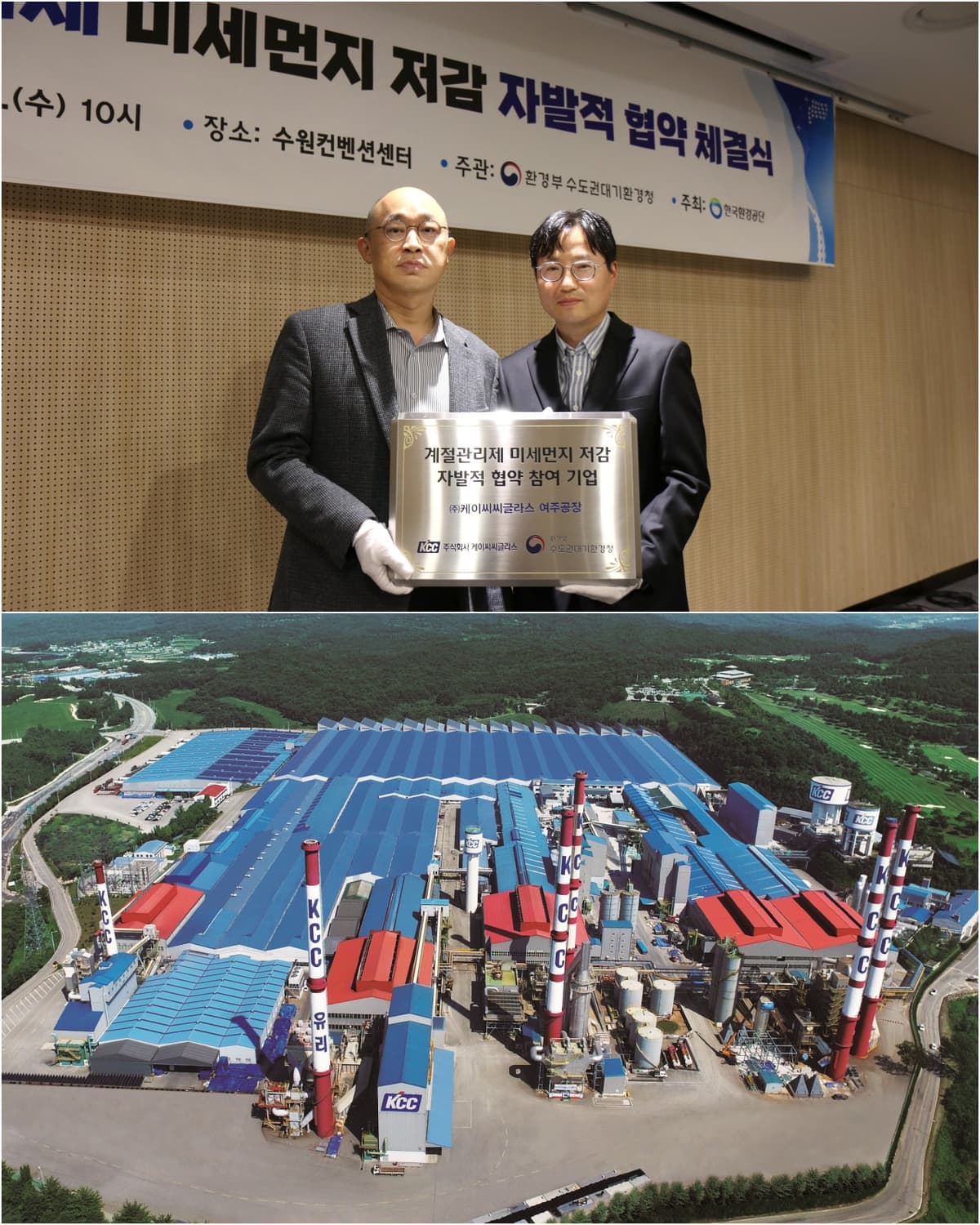
KCC Glass (CEO Jung Mong-ik) has signed an agreement with the Metropolitan Air Quality Management Office and is taking the lead in improving air quality in the metropolitan area.
Through a signing ceremony held on December 13 last year at the Suwon Convention Center, KCC Glass concluded a ‘Voluntary Agreement on Fine Dust Reduction under the Seasonal Management System’ with the Metropolitan Air Quality Management Office, an agency under the Ministry of Environment. The ceremony was attended by Park Ryun-min, Director of the Metropolitan Air Quality Management Office, Kang Hyun-min, Executive Director in charge of technology at KCC Glass’s Yeoju Plant, and representatives of the 16 participating companies.
The main purpose of this agreement is to improve air quality in the metropolitan area by reducing air pollutant emissions during periods of high fine dust concentrations. To this end, the participating workplaces, including KCC Glass’s Yeoju Plant, aim to cut emissions of nitrogen oxides (NOx) and sulfur oxides (SOx) by more than 10% below the legally mandated minimum emission standards during the 5th and 6th Fine Dust Seasonal Management periods (December 2023 to March 2024, and December 2024 to March 2025).
KCC Glass plans to establish its own standards, which are significantly stricter than the minimum emission standards, and to continue its efforts to operate the environmental facilities at the Yeoju Plant optimally during the agreement period. KCC Glass’s Yeoju Plant became the first in Korea to introduce a ‘Ceramic Catalyst Filter (CCF)’ at one of its flat glass melting furnace facilities, and it is also equipped with a variety of state-of-the-art environmental facilities, including flue gas desulfurization (SDR), electrostatic precipitators (EP), and selective catalytic reduction (SCR) systems. In addition, the company plans to invest 16 billion won to install an additional ceramic catalyst filter, with the goal of putting it into operation next year.
An official from KCC Glass stated, “This agreement is an important step toward a sustainable future,” adding, “In accordance with the terms of the agreement, we will operate our environmental facilities optimally during the seasonal management period while taking the lead in improving air quality through continued investment in environmental equipment.”
Meanwhile, the KCC Glass Yeoju Plant, completed in 1987, produces architectural flat glass as well as coated glass and automotive base glass, and boasts an annual glass production capacity of more than 1.3 million tons—the largest of any single plant in the world.
▲ On December 13, KCC Glass signed the ‘Voluntary Agreement on Fine Dust Reduction under the Seasonal Management System’ with the Metropolitan Air Quality Management Office, an agency under the Ministry of Environment.