
National Institute of Forest Science secures reliability and safety in the timber construction market
Korean Industrial Standards established for structural cross-laminated timber and dried sawn timber
With the recent removal of size restrictions on timber-structure buildings (Nov. 9, 2020), the domestic high-rise timber construction market is expected to expand, making it necessary to standardize the materials used in high-rise timber buildings in order to secure the reliability and safety of the timber construction market.
Accordingly, the National Institute of Forest Science (Director Park Hyun) under the Korea Forest Service announced that it has established two Korean Industrial Standards (KS) — for “structural cross-laminated timber (CLT)” and “dried sawn timber” — reflecting domestic and international industry and technology trends related to high-rise timber construction.
Structural cross-laminated timber (CLT) is a wood product made by bonding layers of timber crossed at right angles. With strength comparable to concrete, it is used to build walls and columns in timber construction. Overseas, it is already a proven building material used in various high-rise timber structures and is called the “concrete of the future.” In Korea, it was used in the country’s tallest timber building, the “Hangreen Timber Hall” (National Institute of Forest Science, Yeongju).
The Korean Industrial Standard for structural cross-laminated timber sets out the product’s definition and quality criteria, and includes performance standards for structural cross-laminated timber used in the structural design of buildings, as well as inspection and evaluation provisions.
Dried sawn timber is a basic wood product used throughout the timber industry. Because insufficiently dried timber can develop defects such as warping and cracking during use, this newly established Korean Industrial Standard sets out quality criteria for dried sawn timber, including moisture content and dimensions, along with quality-labeling methods.
Son Dong-won, head of the Wood Industry Research Division at the National Institute of Forest Science, said, “By establishing quality criteria for wood products widely used in timber construction, this Korean Industrial Standard will not only help establish order in the distribution of the timber construction market but also serve as a pillar for ensuring the structural performance and safety of the high-rise timber buildings that will increase in the future.” He added, “As the institution responsible for standardizing the quality and technology of wood products, the National Institute of Forest Science will lead the way in setting standards for the quality and technology of wood products in the timber and timber-construction fields with professionalism and a sense of responsibility, so that the public can use more wood products with confidence.”
This establishment of Korean Industrial Standards (KS) is part of a “regulatory reform” effort that reflects in national standards the practical conditions required to enhance public convenience and support new technology development and new industry infrastructure. The revised standard content can be found on e-Nara Standard Certification (www.standard.go.kr).
▲ Structural cross-laminated timber (CLT)
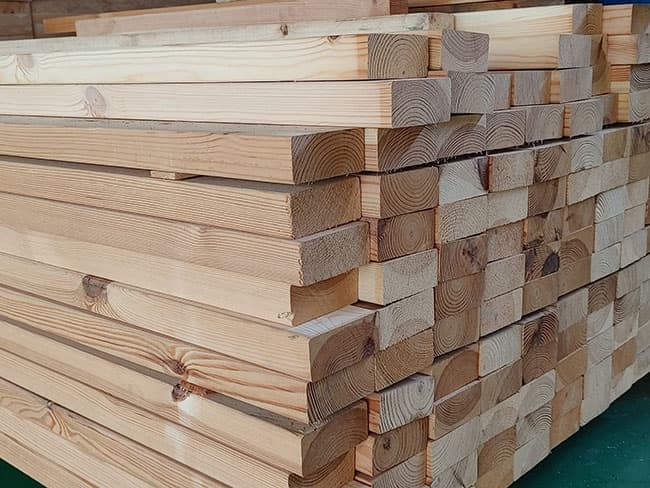
▲ Dried sawn timber