Kim Tae-ho, a Leading Dansaekhwa Artist
From Zen to Ontology
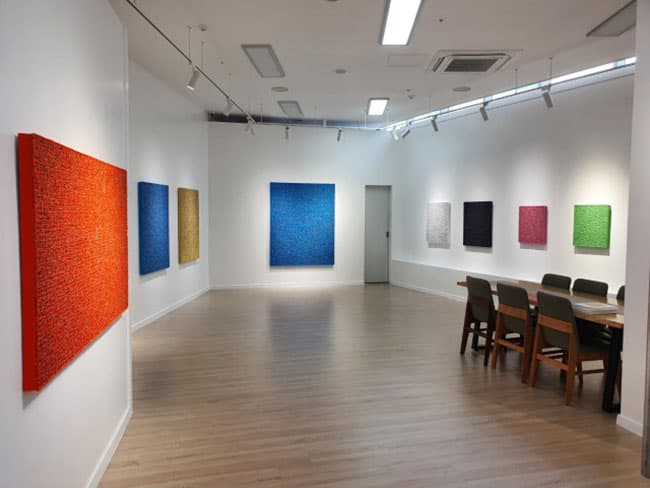
Leeseoul Gallery, located in Hapjeong-dong, Mapo, Seoul, is holding a solo exhibition of Kim Tae-ho—a leading Dansaek-hwa artist carrying on the lineage of Park Seo-bo and Ha Chong-hyun—through May 31.
Subtitled “Internal Rhythm - Fractal Microcosmos,” this exhibition presents 15 of Kim Tae-ho’s recent works. A carefully selected range of pieces in various sizes and colors, from 100 ho down to 10 ho, is on display.
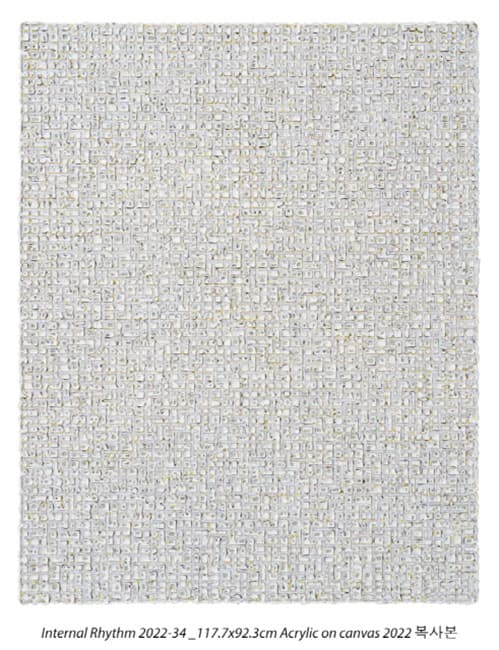
Kim Tae-ho’s Dansaek-hwa works are the outcome of a creative act carried out under the proposition of “Internal Rhythm,” in which, against a grid pattern on the canvas, the canvas is turned at right angles countless times while paint is layered thousands of times, horizontally and vertically. Emerging as monochrome painting through accumulated layers of paint, it can be called the essence of monochrome structural painting, in which an invisible spirituality is rendered visibly material (物化).
Within his works reside the spirituality and thought of the East and the materiality and sensation of the West. The colors and forms present in the finished work are the artist’s spirit and body themselves. It is a creative labor of empty-mindedness and forbearance. The countless honeycomb shapes completed through the overlaying of lines and colors expand from the spiritual world of Zen (禪) into a cosmic ontology.
Regarding Kim Tae-ho’s work, art critic Kim Bok-young remarked, “For example, whereas earlier generations successively emphasized the unification of material existence and the subject (Chung Chang-sup), the purposelessness of the act and automated technique (Park Seo-bo), and an ensemble of nothingness, body, and image achieved through the back-pressure method (背壓法) (Ha Chong-hyun), Kim Tae-ho demonstrates a distinctiveness in employing intaglio-cameo craftsmanship through the method of the fractal.”
On “Internal Rhythm,” Kim Tae-ho himself said, “Internal Rhythm is a relief painting of ridges and grooves formed of a regular grid of warp and weft. First, I draw grid lines on the canvas. Following the lines, I strike and build up paint with a brush in a steady rhythm and order. Usually I accumulate about twenty layers of color planes, and when I carve into the thickly built-up surface with a scraping knife, the color dots hidden within the paint layers come to life, so that the inner rhythm and the outer structure are achieved at the same time. It is a surface like the doorframe of an old hanok, like a country wall, like densely woven fabric. Between the grids woven through the repetition of the accumulating act, countless small square rooms are built. In each small honeycomb-like room, I see a microcosmos radiating its own life.” In other words, it is a Cameo Fractal Microcosmos.