
Seoul Museum of Art (SeMA) Seosomun Main Building, Outdoor Sculpture Park, and Deoksugung Garden
A solo exhibition by leading contemporary French artist Jean-Michel Othoniel
The Seoul Museum of Art (Director Baik Jisuk) is presenting <Jean-Michel Othoniel: Treasure Gardens>, a solo exhibition by Jean-Michel Othoniel—one of France's foremost contemporary artists, widely known for his "glass bead sculptures"—at the Seosomun Main Building, the Outdoor Sculpture Park, and Deoksugung Garden through August 7.
This exhibition is a solo show by French-born artist Jean-Michel Othoniel (b. 1964), who has presented a world of beauty and wonder by weaving together a variety of materials—such as glass, stainless steel, and gold leaf—with rich layers of meaning. It is his largest exhibition since his 2011 show at the Centre Pompidou in France. Bringing together 74 major works that make up Othoniel's artistic world, the exhibition surveys the practice he has developed over the past decade.
The exhibition's title, "Treasure Gardens," refers to the several actual exhibition sites while also encompassing the notion of places seen anew through art, as well as the garden of contemplation that takes shape in the viewer's mind. As an extension of the public outdoor installation work the artist has pursued since the early 2000s, this exhibition unfolds across the Seoul Museum of Art, the Outdoor Sculpture Park, and Deoksugung through the medium of the "garden"—the artist's primary source of inspiration—reaching the public in a variety of spaces beyond the museum. The recommended viewing route begins with Deoksugung, then proceeds through the Seosomun Main Building's Outdoor Sculpture Park and into the galleries.
Since 2000, Othoniel has continually sought encounters between art and the public in public spaces such as the Paris Métro stations in France, as well as the Palace of Versailles and the Petit Palais. His <Kiosque des Noctambules (Kiosk of the Night Walkers)>, installed in 2000 at the Palais Royal–Musée du Louvre station, was a commissioned work commemorating the 100th anniversary of the Paris Métro's opening, drawing attention with a folly that felt like entering a magical space. "I have a vision and a longing to leave the museum and go out into the streets. Art and the artist must go out to meet the public," says Othoniel, whose world resonates with public spaces where people's lives, nature, history, and architecture come together, unfolding in forms like knots that connect them all.
Related programs include <Walking the Gardens of Jeongdong>, which explores the history and culture of Deoksugung Garden, the Seoul Museum of Art, and Jeongdong-gil. In addition, to expand opportunities for cultural enjoyment that have declined since the pandemic, the museum will invite out-of-school youth to a curator-led exhibition tour program. Furthermore, <Tour by Othoniel> (working title), a video in which the artist explains the exhibition, will be uploaded to the Seoul Museum of Art's YouTube channel.
▲ A detail of <The Knot of Mirrors>, a guardian of beauty and an homage to art, on view in <Jean-Michel Othoniel: Treasure Gardens>. ⓒ Kim YongKwan, courtesy of the Seoul Museum of Art
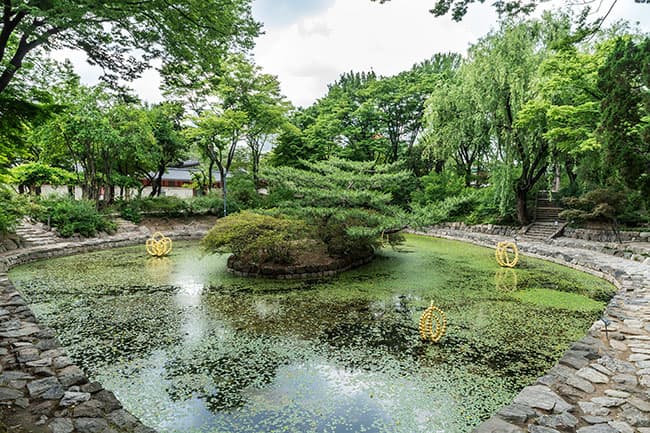
▲ <The Gold Lotus>, an enlightenment offered by the history and nature of Deoksugung, and <The Gold Necklace>, an offering of hope and longing While hoping to carry out a project in Korea's historic palaces and gardens—where nature, narrative, and symbolism come together—Othoniel saw the pond at Deoksugung, with its surface covered in lotus leaves and its small island, and immediately chose Deoksugung as an exhibition site. Reflecting on the history that has unfolded in a palace whose name signifies virtue and longevity, Othoniel installed <The Gold Lotus>, made of stainless steel beads hand-covered in gold leaf as a symbol of asceticism and enlightenment. On the branches of a tree on the island, he hung <The Gold Necklace> to express a wish for dreams to come true. The necklace hanging from the tree recalls humanity's long-standing custom of making wishes at sacred trees, symbolizing—like a "wish tree" on which wishes are written—the longings within us and our hopes for the future. <The Gold Necklace> is also installed on a tree in the Seoul Museum of Art's Sculpture Park, linking Deoksugung and the museum and transforming the surrounding scenery into a new space. ⓒ CJY ART STUDIO
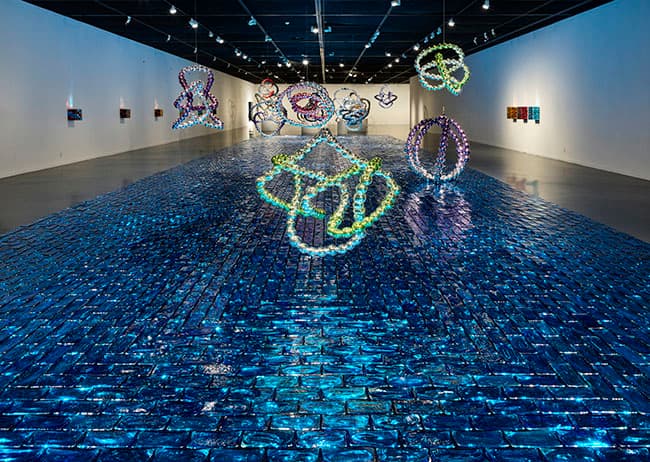
▲ <The Blue River> (the largest of its kind), which embraces wounds and opens onto a new world of hope; <Precious Stonewall> (a partially new work) expressing the will to overcome COVID-19 and prayers for the future; and <Wild Knot>, expressing a universe of infinitely open possibility and connection The monumental installation filling the first-floor gallery of the museum comprises three works. First, <The Blue River> is a floor installation composed of some 7,500 glass bricks produced in collaboration with Indian glass artisans. From a distance, Othoniel's glass bricks gleam, but on closer inspection they contain tiny bubbles and impurities, expressing the real-world fragility of beauty and the wounds of dreams. <Precious Stonewall>, in which glass bricks are installed as hexahedral reliefs, is a series that extends the artist's experience of the COVID-19 pandemic, following his homage to the 1969 Stonewall uprising in New York that became the starting point of the LGBTQ movement. The two events, differing in time and aim, share the will to overcome and the sense of liberation demonstrated by powerless individuals, which the artist renders through minimal forms and reflected light that flickers like flames. The sculpture suspended from the ceiling expresses a "wild knot," a mathematical term for a knot that can undergo infinite transformation in three-dimensional space without ever coming undone. <Wild Knot> is a series of knots developed since around 2015, drawing on the relationships among the symbolic, the imaginary, and the real posited by French psychoanalyst Jacques Lacan. The worlds of the symbolic, the imaginary, and the real—reflecting and relating to one another in endless transformation—constitute Othoniel's aesthetic and his view of the universe, as well as the vision the artist wishes to share with viewers. ⓒ Kim YongKwan, courtesy of the Seoul Museum of Art