
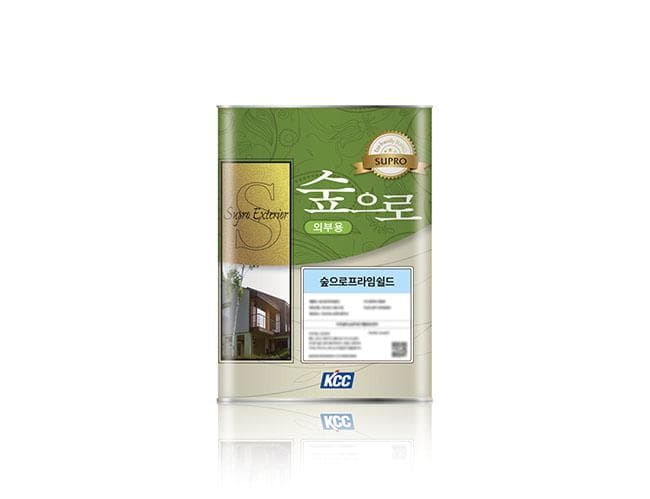
KCC (CEO Chung Mong-jin) has launched 'Supuro Prime Shield,' a high-performance waterborne exterior paint that helps extend a building's lifespan simply by being applied.
'Supuro Prime Shield' is a waterborne paint made with a water-soluble silicone-modified acrylic resin. It forms a thin, strong, highly weather-resistant protective coating over concrete that prevents reactions with carbon dioxide. In addition, it forms a highly elastic coating that protects against fine cracks in exterior walls, and its excellent water repellency suppresses moisture penetration from outside, preventing the neutralization of concrete and thereby extending the building's lifespan.
'Supuro Prime Shield' is an eco-friendly paint that meets KSM6010 Type 1, Class 1—which can be considered the highest grade among the paint classifications applied to the exterior walls of apartments and buildings. It has also obtained a non-combustible material test report in line with enhanced safety standards, and it is endowed with anti-mold performance that suppresses the growth of mold on exterior walls caused by the high-temperature, high-humidity climate of summer.
This principle can be understood by examining the composition of concrete. Concrete contains calcium hydroxide and is strongly alkaline, so when it reacts with carbon dioxide in the atmosphere it loses its alkalinity and enters a neutralized state, which accelerates the corrosion of steel. Ultimately, the expansion pressure caused by the corrosion of the reinforcing steel produces cracks in the concrete. The key to extending a building's lifespan is to protect the reinforced concrete structure from the external environment and maintain its durability.
A KCC official stated, “The durability of concrete is closely related to the lifespan of a building, and Supuro Prime Shield will serve as an auxiliary material for long-life structures,” adding, “It is highly meaningful because it can prevent the deterioration of concrete structures, including apartments, thereby leading to the efficient use of construction resources, and it can also contribute to ESG management by reducing construction waste and carbon emissions.”
Meanwhile, with the 2021 amendment to Article 44 of the Construction Standards Promotion Act—KDS 14 2000 Concrete Structure Design Standards—the required strength of exterior wall concrete, excluding waterproofed wall surfaces, was raised from 27 MPa to 30 MPa. This is intended to prevent the rising social costs, such as resource waste and environmental problems, that result from repeated reconstruction due to short housing lifespans. The Long-Life Housing Construction Certification Standards implemented in 2018 can be regarded as a certification system carried out with the same purpose. 02-3480-5000