
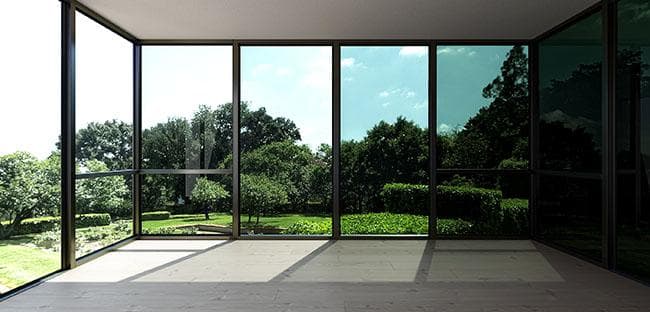
Hanglas has introduced products from the U.S. smart glass manufacturer ‘HALIO.’ Founded in California, USA in 2010, HALIO is making a full-fledged entry into the domestic market through its collaboration with Hanglas.
HALIO’s ‘smart glass’ is an electrochromic type that automatically detects incoming sunlight and adjusts the glass’s tint and transparency. Compared with competing products, HALIO’s products change color faster, transitioning from clear glass to gray—rather than blue—tinted glass within three minutes regardless of window size, and they feature HALIO’s proprietary technology that enables uniform yet fine control. In addition, by leveraging cloud-based artificial intelligence (AI), the system analyzes sunlight levels and energy savings in real time and provides a monitoring service; since there is no need to install separate blinds or shades, an open, unobstructed view is also maintained.
When HALIO is applied to a building, the glass darkens through manual and automatic control to block solar heat entering the interior, thereby reducing cooling loads during the sweltering summer, while in winter it lets solar heat pass through as is to reduce heating loads. Because it can cut energy consumption by up to 20% compared with using standard Low-E glass alone, the application of smart glass to major public institution buildings, airports, and commercial buildings continues to expand overseas.
Placing energy reduction as its top priority, Hanglas is participating in ESG management by expanding the development of eco-friendly products and building eco-friendly plants to realize zero-energy buildings. To foster the eco-friendly construction market, the company plans to broaden its product portfolio as a Solution Provider, going beyond the realm of conventional building materials to build a smart and comfortable living environment.
A Hanglas official said, “While there is ongoing discussion about zero-energy buildings, there are still no regulations related to smart glass. However, as the zero-energy building component technologies recommend an SHGC (Solar Heat Gain Coefficient) of less than 0.3 for non-residential buildings, and the regulations for the supply of high-efficiency energy equipment for construction stipulate a curtain wall performance standard of SHGC 0.4 or lower, the importance of the solar heat gain coefficient is emerging, so the smart glass market is expected to gradually expand going forward,” adding, “Having introduced HALIO to the domestic market this year, we plan to unveil smart glass developed with a domestic company using purely domestic technology sometime next year.” 02-3706-9114