
Obtains official test reports certified by the Korea Laboratory Accreditation Scheme (KOLAS)
Aluminum-frame L/S and T/T system windows secure stability
Gonggan System Windows (CEO Yeom Hyun-jun) has obtained official test reports in the field of aluminum system windows from the Korea Institute of Architectural Energy Technology, a KOLAS-accredited body under the Korea Laboratory Accreditation Scheme.
These KOLAS reports cover wind load resistance (KS F 2296) and watertightness (KS F 2293), and the products tested were Gonggan System Windows' L/S (Lift & Sliding) and T/T (Tilt & Turn) system windows. For wind load resistance, deformation test results of 0.002 mm and 0.007 mm at a maximum test pressure of ±2,800 Pa achieved a Grade 280, while watertightness achieved a Grade 35 in temperature, humidity, and air-pressure testing.
Wind load resistance and watertightness are important because strong wind and rain and other external natural conditions can cause damage to homes and even injury to people. Wind load resistance refers to the degree to which a window withstands strong external wind pressure. If the window frame sags or gaps develop, the glass pane can dislodge under fierce winds, leading not only to property damage but even to loss of life. Watertightness refers to the degree to which rainwater penetrates indoors due to external wind pressure during heavy rain. Low watertightness allows rainwater to enter through osmotic pressure, causing mold to form.
Gonggan System Windows' L/S and T/T system windows have an aluminum-frame structure that is highly resistant to wind. Even after prolonged exposure to the elements, there is no window-frame sagging from contraction and expansion, nor any gap forming between the window and the frame.
Rainwater does not seep indoors through the window, and condensation drains easily. A frame-integrated structure that prevents rainwater overflow, a specially designed water cap with a triple-blocking system, and a triple gasket made of rubber and urethane provide excellent sealing that enhances watertight performance.
In addition, the windows have an average thermal transmittance of 0.978–0.998 W/㎡. Considering that the required thermal transmittance for this part of a building by region is 1.300 W/㎡·K or less in Central Zone 1, 1.500 W/㎡·K or less in Central Zone 2, and 1.800 W/㎡·K or less in the Southern Zone, their thermal efficiency is excellent. Their airtightness, which blocks air infiltrating from outside, also averages 0.00–0.22 ㎥/㎡h, creating a living space that is cool in summer and warm in winter.
CEO Yeom Hyun-jun said, "Amid a rapidly changing climate, by having the stability of our products recognized by an accredited institution through quality testing of aluminum system windows, we have created an opportunity to provide quality service to buyers of high-end detached houses."
Meanwhile, Gonggan System Windows is a company specializing in the production of aluminum system windows, including high-insulation system windows, system doors, and curtain walls. Its products have been applied to the Japanese Ambassador's Residence, the King Sejong Antarctic Station, Lotte Homeshopping, CHA Hospital, the German School, and numerous high-end houses and villas, earning recognition for their design and quality.
▲ Example installation of L/S (Lift & Sliding) system windows
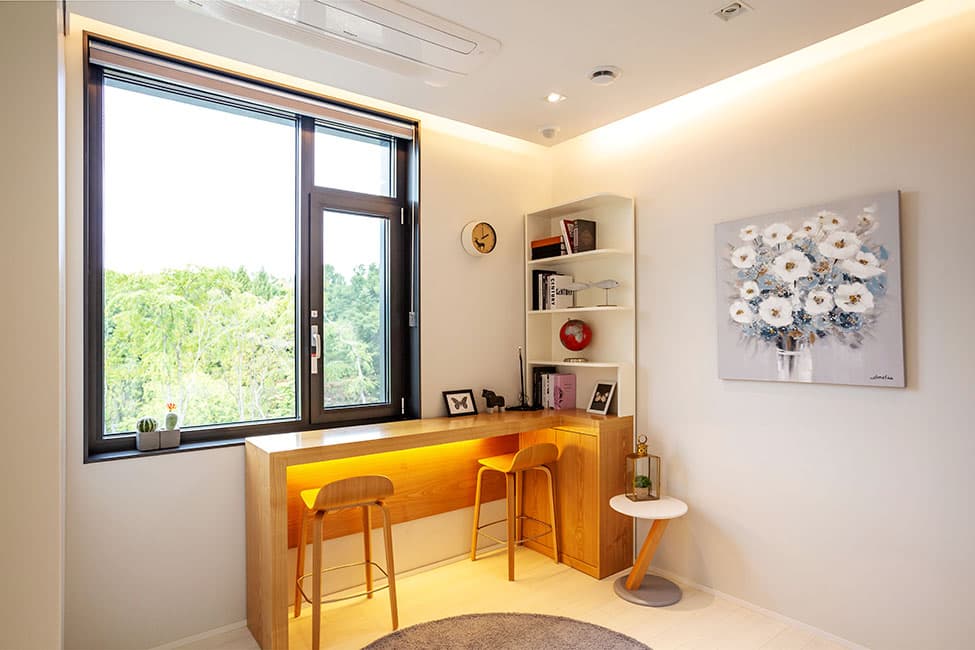
▲ Example installation of T/T (Tilt & Turn) windows in a child's room
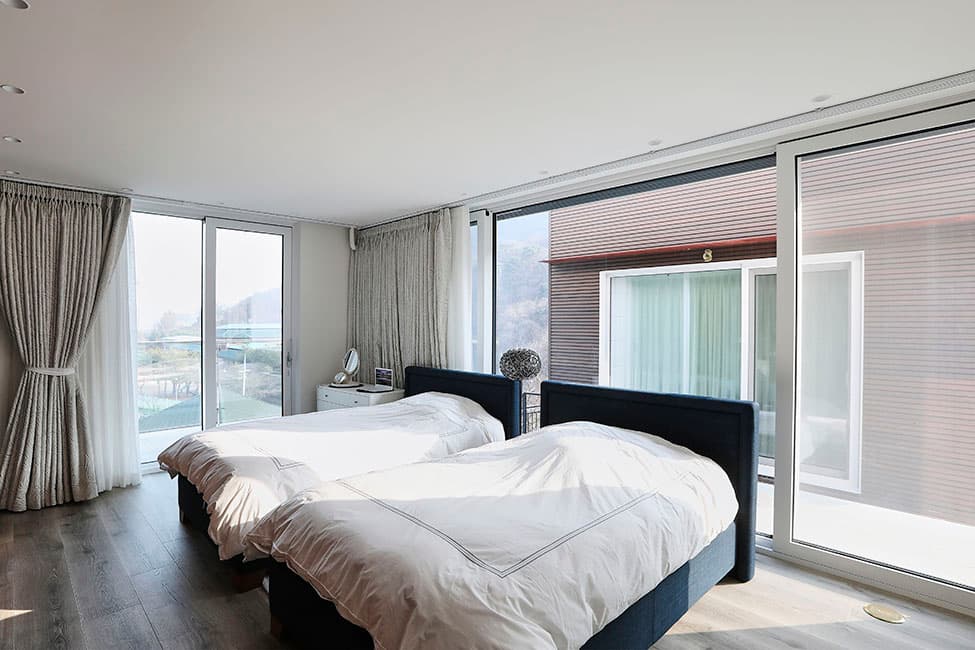
▲ Example installation of L/S (Lift & Sliding) system windows in a bedroom