
GfK Releases Findings: Despite Contraction in the Home Appliance Market, the Robot Vacuum Market Expanded to KRW 290 Billion in 2022
Sales of Premium Products Priced at KRW 1 Million or More Surge 141%
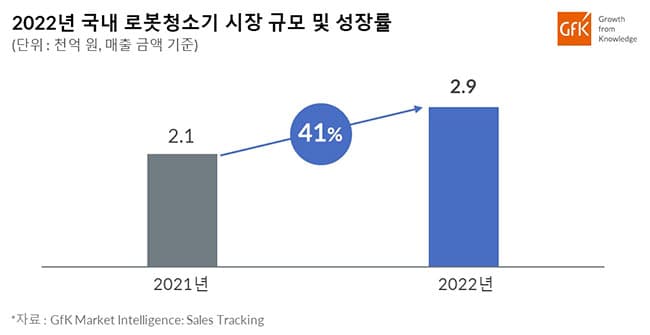
Despite a slowdown in consumer spending driven by inflation, Korea's robot vacuum market posted a robust growth rate of 41% last year compared to 2021.
According to global market intelligence firm GfK, the domestic robot vacuum market — which had steadily expanded on the back of high convenience to reach KRW 210 billion in 2021 — grew even further in 2022 to become a KRW 290 billion market. The market is rapidly expanding as automated features not offered by conventional vacuum cleaners win strong support from consumers.
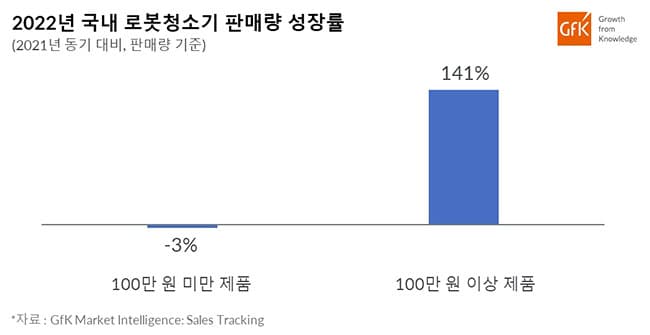
A defining feature of 2022 was the expanded launch and strong sales of high-end products. As the robot vacuum market gradually matures, manufacturers continue to introduce features that are differentiated from and upgraded over existing robot vacuums. In particular, 2022 saw a notable wave of high-end product launches that further enhanced convenience — with features such as automatic mop washing and drying — and enabled efficient cleaning of spaces through upgraded sensors. Even though these products cost as much as twice or more than robot vacuums with basic functions, the segment of consumers who want high-end features that free them from the time and labor required for cleaning has continued to grow, driving strong sales gains. In 2022, unit sales of products priced under KRW 1 million fell 3%, but sales of premium products priced at KRW 1 million or more surged 141%, leading the growth of the robot vacuum market.
Thanks to robot vacuums, which are broadening their consumer base with outstanding functionality and convenience, changes are also being detected in the overall vacuum cleaner market. Long regarded as a secondary product, robot vacuums accounted for just 9% of vacuum cleaner market revenue in 2019, but their share rose to 22% in 2022 — an increase of 13 percentage points — while handheld stick vacuums, the mainstream of the vacuum cleaner market, fell 10 percentage points from 2019. This shows that consumer perceptions of robot vacuums and their standing in the vacuum cleaner market are gradually rising.
Kim Do-hoon, a researcher at GfK, said, "Consumer perceptions of robot vacuums are becoming more positive, and a growing number of consumers are choosing robot vacuums instead of handheld stick vacuums," adding, "With products that combine Internet of Things (IoT) and artificial intelligence (AI) technologies to simultaneously offer consumers convenience and satisfying functionality continuing to launch, we forecast that the robot vacuum market will keep expanding in 2023 as well."
Next-Generation 'LDS' Sensors Deliver Outstanding Mapping; Mopping Function Upgraded
The most crucial element in robot vacuum design is 'cleaning algorithm' technology. The key is to have the robot vacuum recognize an algorithm that can clean every nook and cranny of a home accurately, without missing a spot. What distinguishes the latest robot vacuums from earlier products is that this algorithm has been made possible by the incorporation of more advanced 'sensors.'
The older-generation 'gyroscope' sensor is a device used to measure or maintain direction, and because it only moves along an initially set path, it cannot recognize or avoid obstacles in real time. By contrast, the 'LDS (Laser Distance Sensor)' — also called a Lidar sensor — is the type of sensor mounted on self-driving cars. It uses lasers to scan the cleaning space at high speed across 360 degrees, measuring distance based on the time it takes for the laser to reflect off walls or obstacles.
In addition, a Reactive AI camera that recognizes objects checks throughout the space, identifying the location and size of pets, pet waste, toys, power strips, floor lamps and other items that hinder cleaning, and marks them on the map. Smart app functions also enhance ease of use. By linking a smartphone app, users can use an editing function on the map created by the robot vacuum to divide and partition rooms, as well as set no-entry zones and virtual walls.
In particular, the mopping function — which consumers have recently shown the greatest interest in among robot vacuum features — has been significantly upgraded. Whereas the mopping robot vacuums released as recently as early last year still required users to manually attach, detach and wash the mops, recently launched premium robot vacuums perform dust suction and mopping simultaneously, returning on their own to a docking station — a kind of 'home' for the vacuum — during cleaning to wash the mop, and once cleaning is complete, carry out washing and even hot-air drying. On top of this, an automatic dust emptying function suctions dust into a dust bag inside the station, so users only need to replace the dust bag once every one to two months, doubling the convenience.
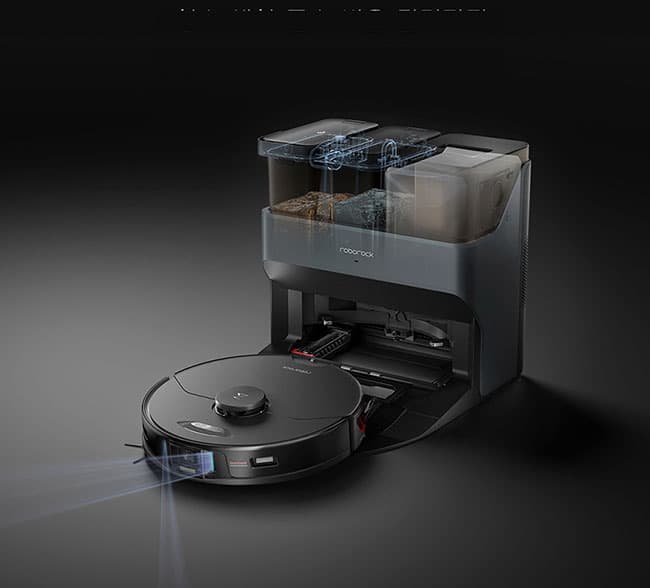
▲ 'Roborock S7 MaxV Ultra' The Empty Wash Fill Dock is equipped with main-unit maintenance functions such as dust bin emptying, automatic mop washing, and dock interior cleaning. It washes the mop pad attached to the robot vacuum by moving the dock's built-in cleaning brush back and forth in both directions. When mop washing is complete, the hot-air drying module automatically blasts 45-degree hot air through 26 holes. It also enhances user safety with a position sensor, an infrared sensor, and a temperature control device.
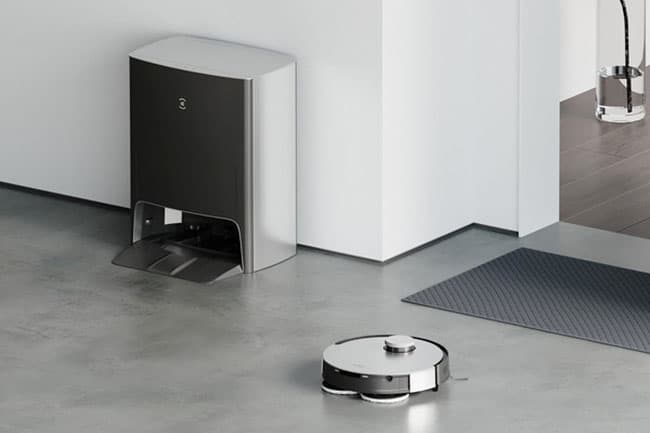
▲ Ecovacs 'X1 Omni' Equipped with the latest dToF sensor and an AI camera sensor, it rapidly maps the indoor layout and accurately identifies the location of even small objects, minimizing unnecessary collisions. It comes with a dual station that combines charging, automatic dust bin emptying, mop washing, hot-air drying, and automatic water tank refilling, and it automatically washes and dries soiled mop pads when the robot vacuum returns to the station after finishing cleaning.
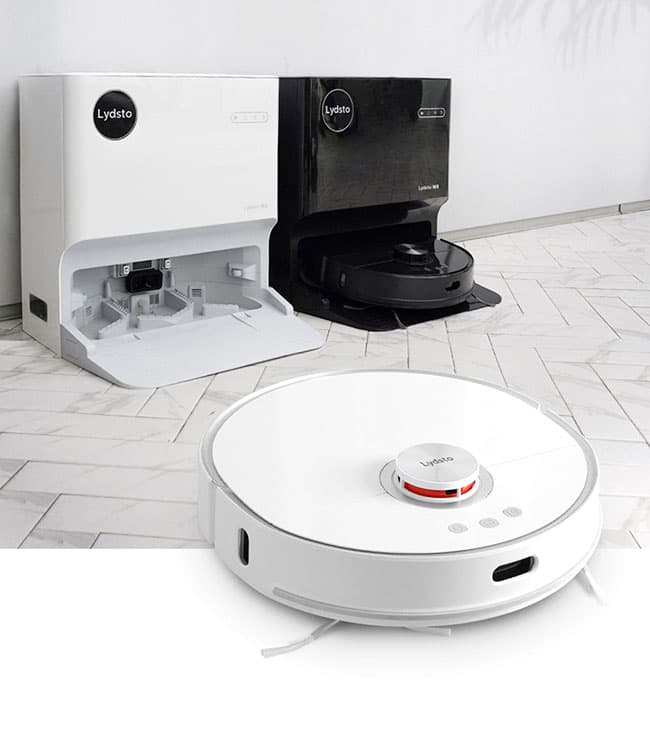
▲ Xiaomi 'Lydsto W2 Full Auto Robot Vacuum' A new product equipped with an auto-cleaning function, it is Xiaomi's 10th-generation model. In addition to vacuum suction cleaning and mopping functions, it also features automatic wastewater recovery, in which dirty water from mop washing is automatically collected into a dedicated wastewater tank. Its 50-degree Auto Pad Cleaning System frequently washes away dirt and stubborn grime with 50-degree warm water during cleaning. It also dries within two hours using 60-degree high-temperature hot air.
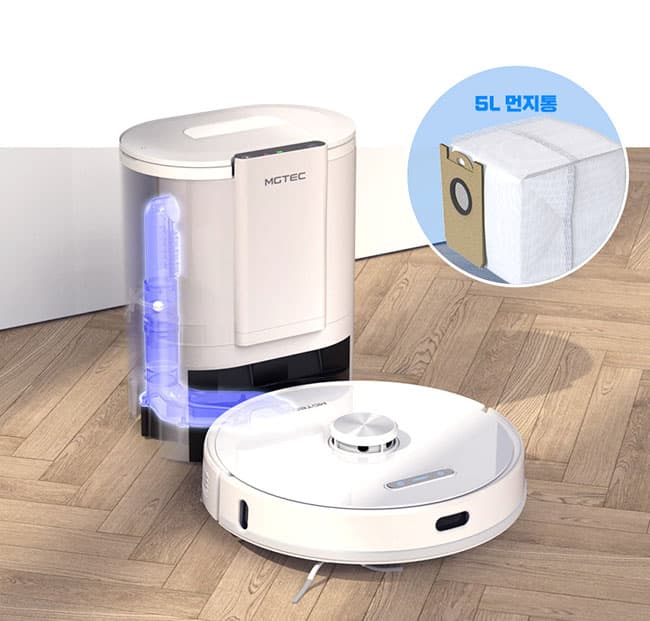
▲ MGtec 'Twinboss S9 Pro' The Twinboss S9 Pro, which applies the dToF 3.0 sensor and LDS sensor used in autonomous driving and drones, cleans by optimizing its travel path through indoor spaces. Its 4-in-1 dust bin is combined with a BLDC motor boasting up to 3,000 Pa of suction power, allowing vacuuming and mopping to be performed separately or together. A built-in H14-grade HEPA filter filters out even the ultrafine dust that can be generated during cleaning.
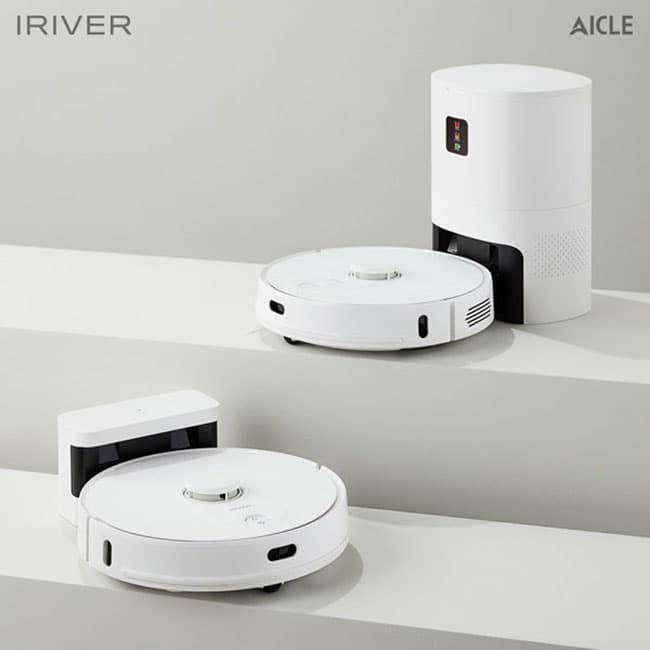
▲ iriver 'AICLE' It comes in two models depending on whether the automatic dust emptying function is included: the Clean Station INS-100 and the Docking Station INR-100. The BLDC motor in the AICLE boasts up to 2,700 Pa of suction power and is equipped with an H14-grade HEPA filter. With a 250 mL water tank, it can be used for up to 70 minutes, and its Y-mode mopping design enables cleaning without blind spots.