
On view at the Seoul Museum of Art (SeMA) Seosomun Main Building through August 8
An exhibition offering an indirect experience of the climate crisis facing our shared planetary ecosystem
The Seoul Museum of Art (SeMA) presents <Climate Museum: The Life of Our House> at its Seosomun Main Building through August 8.
Climate change is the fundamental challenge of our time, one that will shape the future of humanity. In response, SeMA presents an exhibition that confronts the climate crisis and calls for climate action, grounded in its 2021 institutional agenda of ‘Learning’ and its exhibition agenda of ‘Transmedia.’
Based on the research of <Climate Citizen 3.5> (sponsored by Arts Council Korea), this exhibition urges a realistic awareness of the climate crisis. Although it is not an exhibition about solutions to climate change, it draws inspiration from Erica Chenoweth’s research showing that social change becomes possible when 3.5% of a nation’s citizens take action, and it calls for climate action through a shift in awareness.
<Climate Museum: The Life of Our House> reveals the relationship between the ‘big house—the Earth, home to all things and living beings—and the ‘small house,’ the dwellings in which people live, both sharing the same etymological root in ‘oikos.’
The exhibition is composed of a total of three ‘houses,’ set both inside and outside the museum, the ‘house’ of art. The three houses that make up the exhibition—<Oikos of Tragedy> and <The System of the House: Building House—Demolishing House>—are in fact houses for all living beings, humans included. At the meeting points of these three houses, artists, activists, scientists, and architects speak about ocean desertification, glacial loss, rising sea levels, resource exploitation, waste colonialism, and the environmental harms of real-estate logic.
▲The first house is the oikos dying from climate change—the Earth’s ecosystem. Conifers dying off en masse from Hallasan to the Baekdudaegan mountain range. Animals that have lost their habitats and starved. Seas polluted by plastic. The melting sea ice of the Antarctic and Arctic that leads to floods, wildfires, and abnormal temperatures, and data centers whose energy use is surging. Through dead trees, taxidermied animals, and video, visitors experience climate change indirectly within the museum. ▲The second house is the human dwelling that is built and demolished. As roughly 40% of the world’s carbon emissions stem from the construction industry, this house presents the life cycle of Korean dwellings and the objects used in daily life since the modern era. ▲The third house is one that helps bees, birds, and butterflies survive. Erected on the museum rooftop, it is installed—independent of the exhibition schedule or the presence of visitors—from spring, when birds begin to lay eggs and raise their young, until early autumn, when wild bees have gathered pollen and finished preparing for winter. To avoid disturbing the lives of the bees, birds, and butterflies, visitor access is restricted, and it is viewed through telescopes and CCTV screens set up in the museum courtyard.
Meanwhile, to help prevent the spread of COVID-19, SeMA is operating an advance reservation system through the Seoul Public Service Reservation site (yeyak.seoul.go.kr). Detailed information, including exhibition viewing schedules, is available on the SeMA website (sema.seoul.go.kr).
▲ Yoon Suyeon, ‘Jeongseon Cement Quarry,’ from the exhibition <Climate Museum: The Life of Our House>
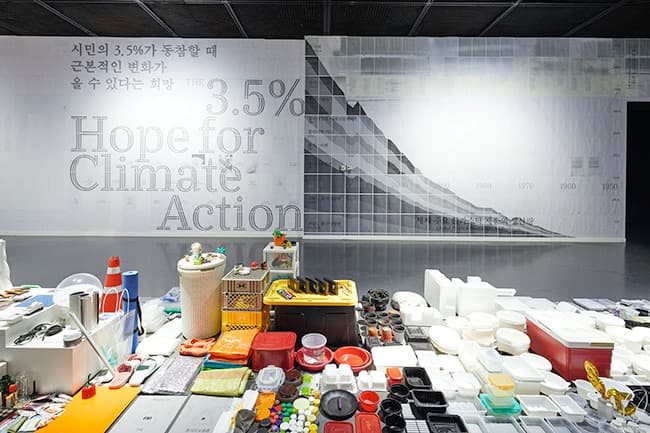
▲ Installation view of <Climate Museum: The Life of Our House>. (Photo by Nam Ki-yong)
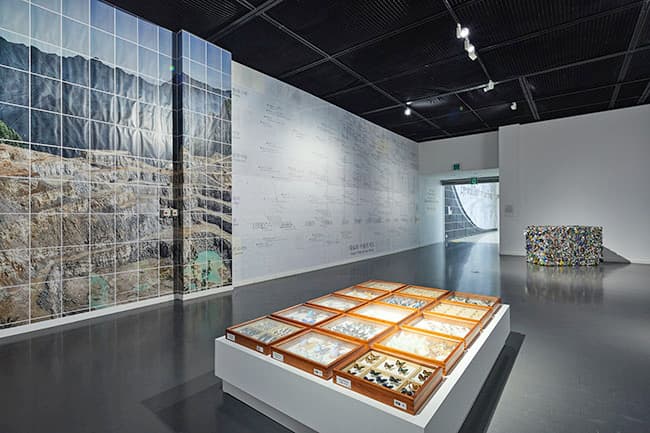
▲ Installation view of <Climate Museum: The Life of Our House>. (Photo by Nam Ki-yong)
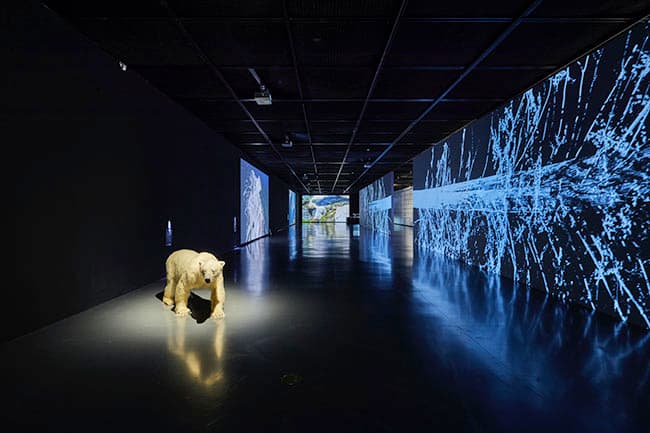
▲ Installation view of <Climate Museum: The Life of Our House>. (Photo by Nam Ki-yong)