‘Theoria-Dream rock’: The Eighteenth Solo Exhibition
Nature’s archetypes and the infinite spectrum of light captured in paintings of stone
The 18th solo exhibition of artist Ha Seok-hong, who creates a wide range of works including paintings and installations using the stones and nature of Jeju as his subject matter, will be held at Rieseoul Gallery.
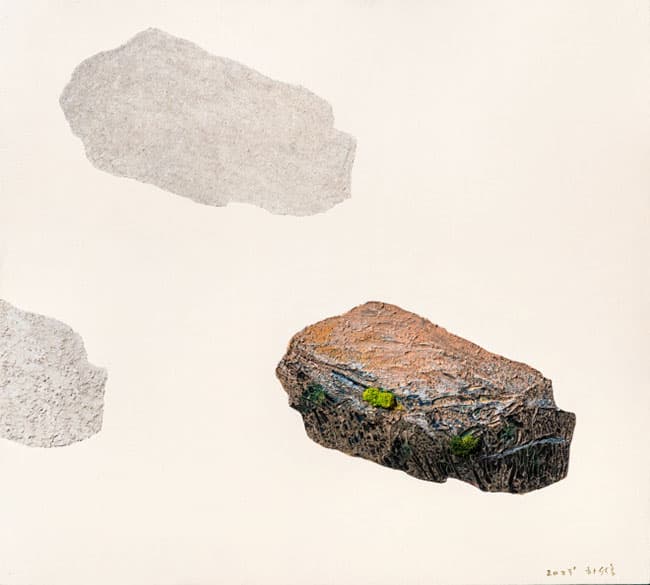
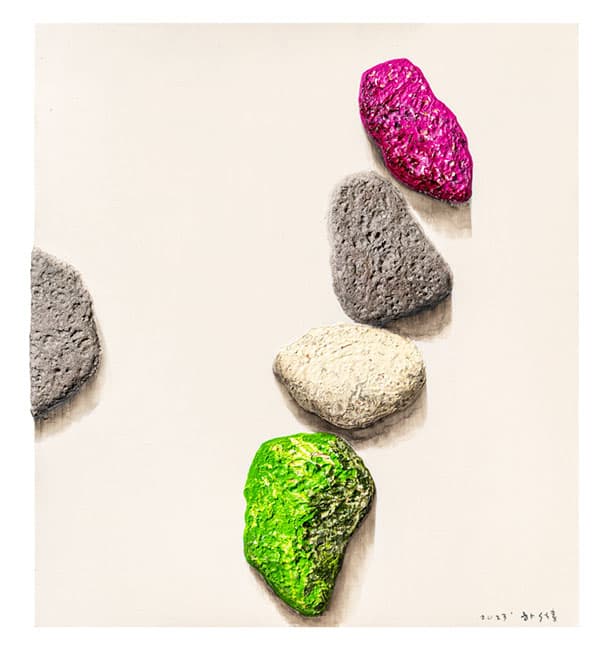
The works Ha Seok-hong presents in this exhibition comprise his signature pieces designated ‘Theoria’ and the colorful pieces expanded into ‘Dream rock.’ These are works in a new form that express the archetypes of matter and nature held within rough textures, and that reproduce the infinite spectrum of light through visual-perceptual imagination.
Generally, to sense something means ‘to see it,’ but philosophically Theoria is used to mean a ‘meditative and self-aware beholding’ of a truth that cannot be grasped.
Ha Seok-hong was born in Jeju in 1962. He has received the Korean Art Critics Association Artist Award (2022), the 1st Art and Criticism Artist Award (2020), and the Popular Artist Award of the special program marking the 26th anniversary of the monthly magazine Misulsegye (2011), among others. He has participated in the Dongin Art Museum Four-Person Exhibition (1983), as a member of the Gwanjeom (觀點) art group (1991), the Seoul Arts Center-organized International Environmental Art Festival ‘Try Walking Barefoot’ (2003), and the Busan Biennale ‘Treading on Nature’ (2006). He specially produces ‘Mongdol (夢돌)’ works using basalt as a motif, employing them in paintings, installations, and performances to realize his artistic originality. Since 2019, he has served as the lead artist of the Chuja Art Island Project under the Village Art Project, demonstrating new attempts in public art.
An artist who was born and raised in Jeju and who makes and paints stones—that is Ha Seok-hong. For him, stone has been treated as a material for creation, a tool of labor, and a symbol of reflection that draws his life’s journey forward, so it is no exaggeration to call him a stone artist. He has lived for some 60 years alongside the roughly textured volcanic rock scattered across beaches and gotjawal forests, and the ways he has shaped and painted stone are as varied as the traces of the years he has passed through. The stone masses he made using natural mineral powder, pigment, and a coagulant on waste-paper pulp aged with microorganisms crossed the boundary between the real and the virtual, creating myths that carry the message of a quasi-nature. From work in which he drew by placing spoons or bowls on rough-textured surfaces or rendered fish as fossil images, to the simulacra series in which he realistically replicated the forms of natural objects such as crows, hackberry trees, and stones, his work of representing stone has been the unique fruit of his labor. This artistic journey of his can be said to be an expression of the individuality gained from the artist’s own life spent in the singular space that is Jeju, and an achievement reflecting a modernist art history that has shifted from narrative to the thing itself.
In this solo exhibition, Ha Seok-hong once again reveals a quiet transformation. The process of that change can be observed through three series: a series in which the texture of rock is laid across the canvas like color-field abstraction; a series depicting images of lichen growing on those rock surfaces; and a series that synthesizes the forms of stones with the lichen images covering their surfaces. If there is a common thematic consciousness running beneath these three series, it can be summarized in the key concepts of environment, ecology, life, and nature. These themes are the discourses of today’s knowledge society in what is called a civilizational turning point. In Ha Seok-hong’s three stone series, we see a fusion of an interest in the world of pure abstraction, a gaze upon material and form themselves, and an intention to reveal a narrative message through the lichen growing on this ground of essence and purity. Lichen (地衣類), whose name means ‘the clothing of the earth,’ is an organism that grows clinging to rocks and trees. That we can discover the contemporary key concepts noted above in the artist’s work is a truly welcome thing. (Kim Young-ho, Professor at Chung-Ang University, art critic)