Achieves carbon neutrality and unveils new sustainability program, 'Brighter Lives, Better World 2025'
Signify (formerly Philips Lighting), a global lighting company leading the lighting industry, announced that it has achieved carbon neutrality across all of its operations worldwide and is now using 100% renewable electricity. At the same time, Signify unveiled its new five-year plan to double its positive impact on the environment and society compared to previous efforts.
Since 2010, Signify has reduced its carbon emissions by more than 70% while implementing sustainability policies on-site, including more energy-efficient technologies, more sustainable modes of transportation, and optimized logistics planning. In addition, through its carbon neutrality program—including the use of 100% renewable electricity supported by power purchase agreements in Texas and Poland—the company is working to balance emissions reductions and contribute to local communities.
Helen Clarkson, CEO of The Climate Group, an international non-profit environmental organization, said, "I would like to congratulate Signify on its major achievement of reaching carbon neutrality across all of its operations in 2020." She added, "We have worked with Signify for more than 10 years to expand the adoption of energy-efficient LED lighting worldwide, and Signify has consistently supported the 'RE100' campaign to transition to renewable energy as well as the 'EV100' campaign, a global initiative to accelerate the shift to electric vehicles." She emphasized, "Because achieving the goals of the Paris Agreement requires halving global carbon emissions by 2030, more companies must set and work toward their own Net Zero targets, just as Signify has done."
Eric Rondolat, CEO of Signify, shared his thoughts, saying, "I am extremely proud of and grateful to all Signify employees for supporting our carbon neutrality goal. This is a truly important achievement for us, and I would like to call on many others to join us." He also stated, "The world is facing significant demographic changes, urbanization, climate change, and resource scarcity, so now is the time to work even harder to solve these problems," adding, "Delivering sustainable growth and a great place to work is one of Signify's core strategies, and in pursuit of sustainability we intend to go beyond carbon neutrality and work to double our positive impact on the environment and society by 2025."
To double its impact on the environment and society, Signify is implementing a new sustainability program, 'Brighter Lives, Better World 2025.' In line with the UN Sustainable Development Goals (UN SDGs), the company plans to pursue a total of four goals, as follows.
▲Signify will reduce carbon emissions across its entire value chain by improving the energy efficiency of its products and driving down the carbon emissions of its customers and suppliers. Signify's LED lighting can save an average of 50% in electricity compared with conventional lighting, and using IoT lighting control systems can save an additional 30% in energy. The expansion of solar lighting systems is also expected to contribute effectively to reducing carbon emissions. Through these efforts, the company expects to achieve the Paris Agreement's 2031 target twice as fast, in 2025.
▲Signify plans to double the revenue from circular products, systems, and services to 32% by focusing on developing remanufactured, refurbished, reused, or recycled products. ▲The company aims to double the revenue generated by lighting innovations that improve food availability, safety and security, and health and well-being to 32% of its current level.
▲Finally, to provide decent jobs, economic growth, and a great place to work, the company announced that it will strive to improve diversity and inclusion by doubling the number of women in leadership to more than 34%. As a leader in sustainability, Signify plans to continuously work toward employee safety and sustainability with its suppliers, as well as contribute to society through the Signify Foundation. 1670-6147
Signify / Signify Korea
Signify (Euronext: LIGHT) is a global leader in professional lighting, consumer lighting, and Internet of Things (IoT) lighting. By providing Philips lighting products, Interact connected lighting systems, and data-enabled services, it is transforming life in homes, buildings, and urban spaces while unlocking business value. In 2018, it recorded sales of approximately 6.4 billion euros, and about 28,000 employees work in more than 70 countries. Signify is committed to unlocking the potential of light for brighter lives and a better world. Signify has been named the Dow Jones Sustainability Index Industry Leader for two consecutive years. Signify Korea (formerly Philips Lighting Korea), a leader in the Korean lighting market, provides LED lighting products, systems, and solutions across a wide range of fields—including homes, offices, buildings, landscapes, and sports—from home lighting to professional lighting. Based on its vision of 'Light Beyond Illumination,' Signify Korea delivers limitless possibilities through high-quality lighting products, connected lighting systems, and services. Meanwhile, Philips Lighting Korea changed its name to Signify Korea on January 28, 2019, in accordance with global headquarters policy. Even after the name change, Signify continues to use the Philips brand under a license agreement with Royal Philips.
▲ 'Hue Go 2.0' With the newly launched second-generation 'Hue Go,' the previous 'Hue Go' could only produce 16 million colors through a separate bridge, but this newly released second-generation 'Hue Go' supports Bluetooth connectivity without a separate bridge, allowing colors to be produced and controlled through a dedicated app. While the previous product could be used for up to 3 hours on a full battery charge, the second-generation 'Hue Go' can be used for 2.5 to 24 hours depending on the lighting mode.
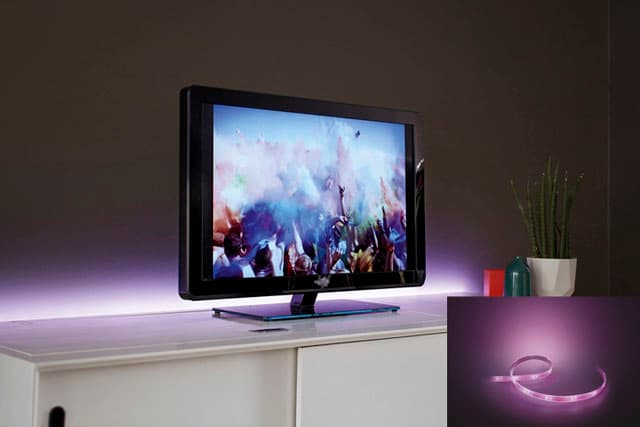
▲ 'Hue Lightstrip Plus 4.0' A linear light densely packed with LED chips, it comes with adhesive tape so it can be attached to TVs, desktops, furniture, and more, and placed wherever desired—such as the living room, bedroom, or kitchen—and can be flexibly installed by bending or turning it in any direction. The product is 2m long and can be extended up to 10m using 1m extension cables. A new feature added in the fourth generation allows part of the strip to be cut off and the remaining strip to be reconnected with a connector for reuse.
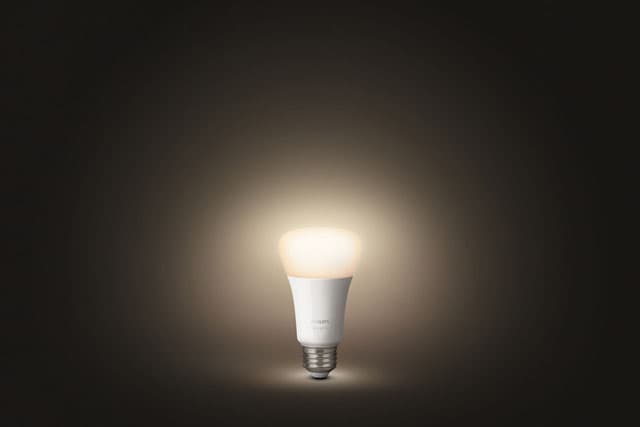
▲ 'Hue White Bulb' In line with the current market trend of favoring soft, comfortable yellow light over the previously preferred bright white lighting, it was released with a color temperature of 2700K. With simple operation, it supports dimming, on/off control, and voice control via Google Home, and through Bluetooth connectivity up to 10 bulbs can be controlled with just a touch on a smart device screen. In addition, it can store patterns that the user repeatedly uses, enabling simple routine settings such as automating the lights to turn on and off at wake-up and bedtime or setting a timer.