2nd floor, Seoul Calligraphy Art Museum, through March 13
Calligraphy that is drawn, made, carved, and danced
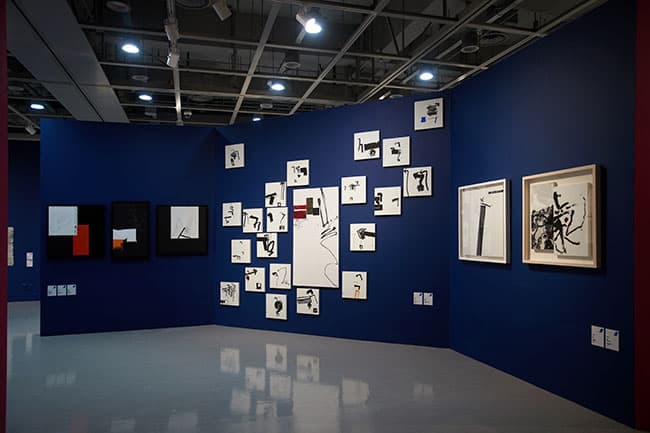
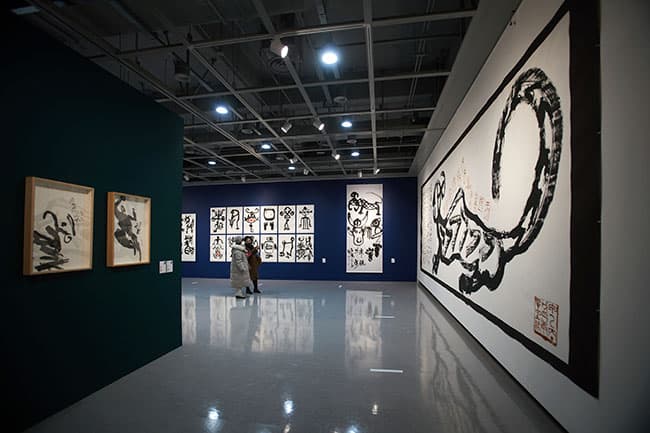
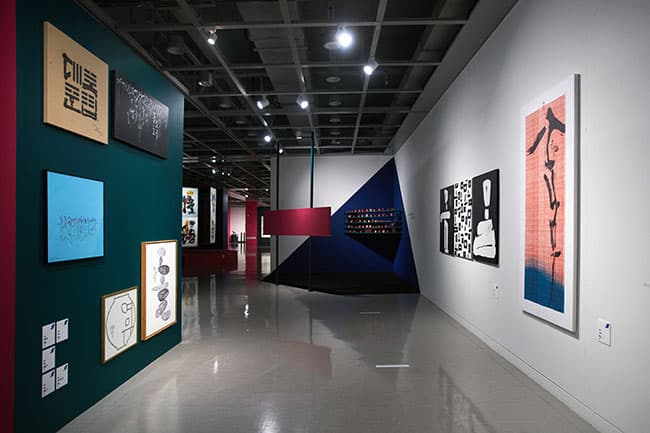
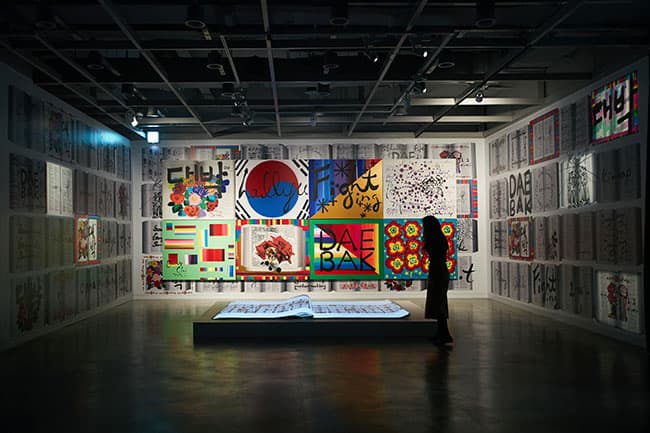
The Seoul Arts Center is presenting <Writing Not Written> in the Experimental Exhibition Hall and Contemporary Exhibition Hall on the 2nd floor of the Seoul Calligraphy Art Museum through March 13. Organized by the Seoul Arts Center and sponsored by the Korea Calligraphy Design Association, this exhibition showcases some 110 paintings, sculptures, and media works related to “writing.”
<Writing Not Written> is the first large-scale calligraphy exhibition organized by the Seoul Arts Center. As the home of the Calligraphy Art Museum—the only museum in Korea dedicated to calligraphy—the Seoul Arts Center has broadened its horizons by embracing not only the traditional calligraphy genre but also a variety of adjacent genres such as graffiti, munjado (letter paintings), chaekgado (bookshelf paintings), and folk painting. The Seoul Arts Center organized this exhibition to discover new possibilities in calligraphy and introduce them to the public.
The exhibition’s title, <Writing Not Written>, expresses an interest not only in the “materialized” works composed of brushstrokes, but also in the act and mindset of writing. It suggests that writing is not necessarily something that is only written. From this perspective, calligraphy expands its genres and media. It writes, makes, attaches, and installs letters, and creates virtual spaces through media. Going beyond the common notion that “calligraphy in the traditional sense belongs to the fine arts while calligraphy in the modern sense belongs to design,” this exhibition reveals the character of contemporary art.
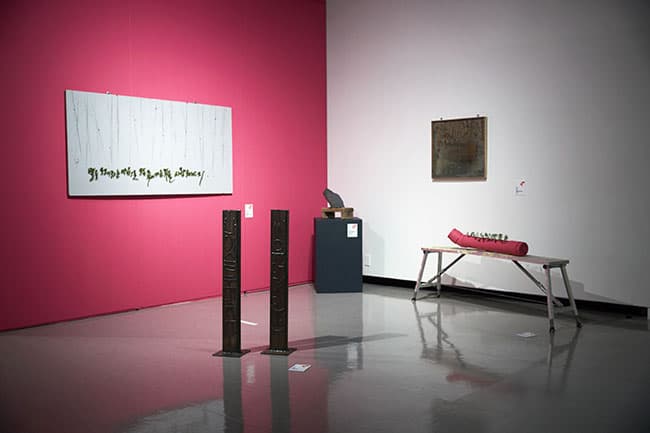
The exhibition is not divided into spaces according to theme. There are only markers that capture the artistic forms of action in calligraphy and classify the works as △Writing by Drawing △Writing by Making △Writing by Carving △Writing by Dancing. Unlike a typical exhibition that divides space by theme and arranges a viewing route to convey the curator’s intent to the audience, <Writing Not Written> places the works without any particular partitioning, allowing viewers to imagine and interpret freely.
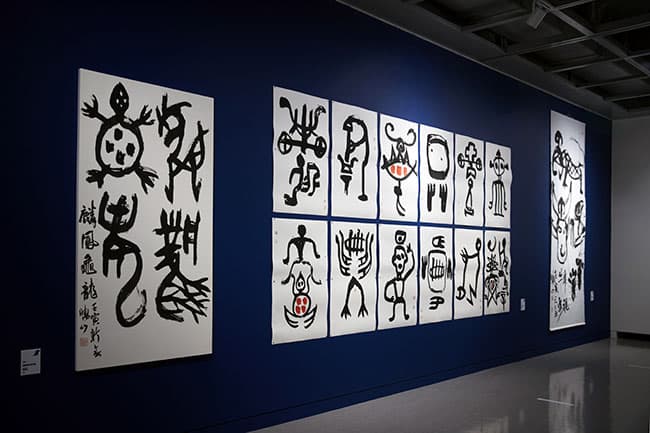
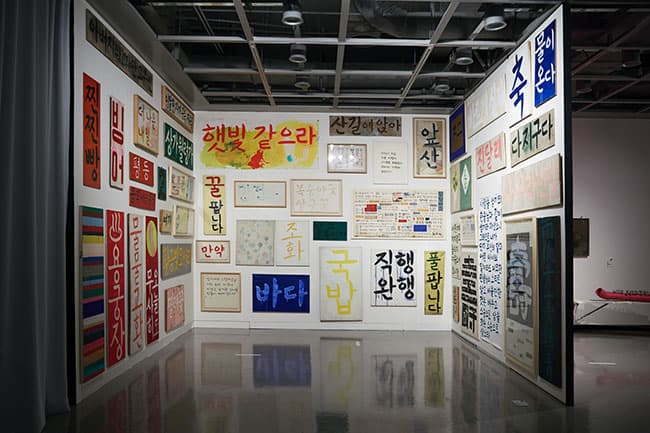
Among these artistic forms of action, “Writing by Drawing” expresses everyday speech and text through drawing. Artists symbolize actions or objects as new pictographs (Kim Young-bae, Son Chang-rak, Park Bang-young, Lee Jae-yeol), give life to emotional states through writing (Kim Sung-tae, Son Dong-jun, Oh Min-jun, Lee Seung-hwan, Lee Jin-kyung), and adopt letter paintings (munjado) or wordplay (Kim Jin-han, Lee Sang-hyun, Lee Su-jin, Cho Jung-wook, Cho Yong-yeon, Choi Il-seop). One artist presents, in vivid colors, the writing of 26 Korean words newly added to the Oxford dictionary on Hangeul Day 2021 (Hong Ji-yoon), while another uses COVID-19 vaccine boxes as objets to pose questions about life today (Hwang Seok-bong). Calligraphy that creates new icons can, like the emoticons of the digital age, serve as a passage that connects letters to meaning, meaning to emotion, and heart to heart.
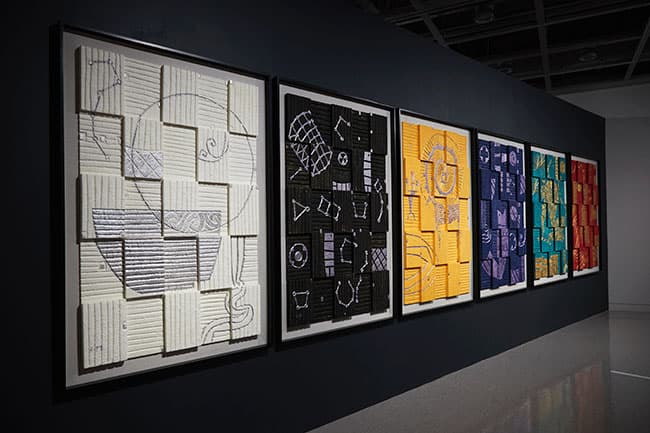
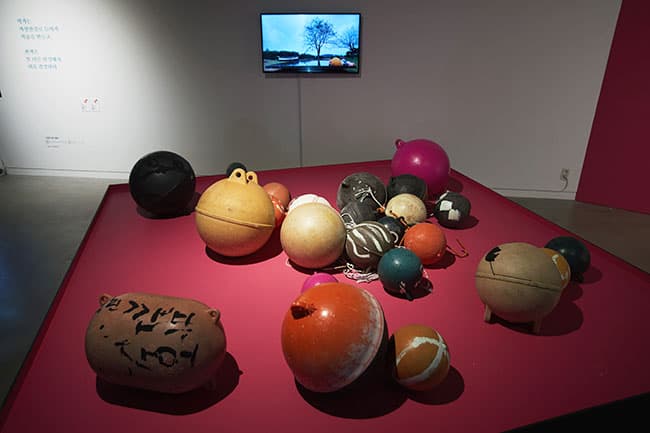
“Writing by Making” goes beyond the boundaries of the picture to make letters. Writing, the most direct form of conveying meaning, becomes an objet at this stage. The meaning contained in the writing mixes with the meaning embedded in the method of production or the material, transforming into a new meaning. Works that draw attention here break the generally accepted forms of calligraphy: a work that uses projection mapping and motion capture technology to expand from “writing that is seen” to “writing that is written” (Lee Ppu-ri), a work that collages ready-made fonts (Lee Jung-hwa), a work that creates letters using diverse materials such as gypsum board, PVC pipes, and roof tiles (Lee Ji-eun), handwriting realized in 3D (Kim Hyun-jung), a work that renders handwriting as typography (Ahn Ma-no), everyday language created by sculptural letters (Lee Jung), and letters shaped from hanji (Korean traditional paper) (Yeo Tae-myung).
Humans have sometimes chosen carving over drawing as a means of communication. For example, they carved non-verbal signs, as in the Bangudae Petroglyphs, or carved and printed language, as in the Tripitaka Koreana. In this exhibition, “Writing by Carving” is presented through works such as tattoos (Oh Mi-ja, Han Si) and seal engraving (Jin Gong-jae, Jung Go-am).
The protagonist of “Writing by Dancing” is dance, which is analogous to writing through the medium of a message. Dance is a non-verbal expressive art, yet it can take the place of speech and text through action. Media installation artist Lee Ppu-ri and the b-boying group Gunies Company awaken a fading sense of community through writing, while the performance creative group Liquid Sound carries on the energy of writing and dismantles fixed notions through traditional performance and dance.
Thus, while the acts of drawing, making, carving, and dancing are acts of “not writing” (不筆), all of these artistic acts are an attitude of applying one’s heart and mind (用). Rather than dwelling on black ink and hwaseonji paper, these works, shaped in rich colors and diverse forms, wittily affirm plural meanings. <Writing Not Written> sought to show that calligraphy is not confined to the form of writing, but is an art that expresses the personal sensibility (寫意) of contemporary people.