Impact Peoples surveys 188 people in their 50s and 60s
Improved quality of life is the reason for preferring rural and detached houses after retirement
At a time when the government's real estate policy has become a hot topic, a survey has been released showing that middle-aged and older people want to change their housing arrangements after retirement.
From November 4 to 18, 2020, Impact Peoples (CEO Shin Cheol-ho) conducted a survey of 188 people in their 50s and 60s, asking about △their current housing type and household size, △the meaning of housing to them, △their preferred housing type after retirement, and △their thoughts on senior community housing. (Respondents' places of residence: Seoul 37.2%, Gyeonggi Province 21.8%, Busan 10.6%, and other regions 1–6%)
When asked about their current housing type, apartments were the most common at 67.6%, followed by detached houses at 16.0%. Household size (including the respondent) was found to be three or more people (34.0%), four or more people (32.5%), and two or more people (29.8%). Single-person households living alone accounted for only 3.7%. Among households of two or fewer, 58.1% lived in apartments, while among households of three or more, 71.9% did—showing a 13.8% difference in housing type depending on household size.
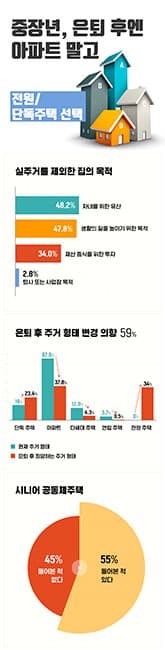
From what perspective do middle-aged and older people view their homes? Many regarded their home as more than a place to live, viewing it as 'an inheritance for their children (48.2%)' or 'a means to improve their quality of life (47.6%),' while 34.0% also considered it a means of investment to grow their assets. (Multiple responses allowed)
When asked whether they had housing plans for after retirement, the most common answer was 'yes (49%),' followed by 'planning to arrange it (31%)' and 'no (20%).' When asked whether they intended to change their housing type after retirement, 'yes' exceeded half at 59%. On this question there was a nearly 10% difference 'depending on current place of residence' (8.9%): 64.7% of non-metropolitan residents intended to change their housing type after retirement, compared with just 55.8% of metropolitan-area residents.
Although 67% of respondents currently live in apartments, the preferred housing types after retirement were rural houses (34.0%) and detached houses (23.4%), which together at 57.4% outnumbered apartments (37.8%). In other words, one in two middle-aged and older people hope to live in a rural house or detached house after retirement.
On this question, too, the opinions of metropolitan and non-metropolitan residents differed by about 10%. Non-metropolitan residents (39.7%) were 8.9% more likely than metropolitan residents (30.8%) to hope to live in a rural house after retirement.
Middle-aged and older people who intend to switch from an apartment to a rural or detached house after retirement said this is because a home is more than just a place to live—it is a space for improving their quality of life.
In addition, when asked whether they had heard of 'community housing where seniors live together (co-housing),' which is emerging as an alternative for the comfortable living of middle-aged and older people after retirement, 55% said they had heard of it and 45% said they had not.
Community housing refers to housing in which people with common needs live together and 'share' goods and spaces to improve their quality of life. It is a form of housing in which residents set up an independent shared community space, establish rules, and engage in community activities through communication among residents. In community housing for seniors, residents can interact in community spaces such as shared hobby rooms and health care rooms, and cooperative communal living—including elderly care—is possible.
Respondents were somewhat positive about community housing, giving it an average of 3.75 points (out of 5). Households of three or more gave it 3.9 points, above the average of 3.75, while households of two or more gave a more muted response of 3.5 points.
When asked whether they were willing to move into community housing, the result was 3.35 points (out of 5). For willingness to move into community housing, positive responses accounted for 49% and negative responses 26%, showing that half of respondents are also considering moving into community housing.
As their biggest concern about moving into community housing, respondents overwhelmingly cited invasion of privacy (70.7%), followed by the home purchase price (41.9%), transportation and commercial-district convenience (24.1%), and investment appeal (22.5%).
Meanwhile, Impact Peoples is a shared-value creation platform that aims to create 10,000 senior jobs and sign up 300,000 members over the next five years.