A three-artist show featuring Jung Youngho, Heo Yeonhwa, and Hong Kiha, through August 27
A curated exhibition spotlighting young artists aged 35 and under
Perigee Gallery presents <inter-face>, a three-artist show featuring Jung Youngho, Heo Yeonhwa, and Hong Kiha, as the inaugural exhibition of ‘Perigee Unfold,’ a new program launching in 2022, running through August 27. ‘Perigee Unfold’ is a curated exhibition program that spotlights young artists aged 35 and under who are steadily developing their own bodies of work.
<inter-face> is a story of young artists—who meaningfully sense the presence of their medium as they build their own visual language—facing one another. An artist’s choice of a creative medium can be likened to setting up one’s own ‘interface.’ Here, ‘interface’ does not refer to a user interface (UI) concerned with the ease of accessing software; rather, it broadly denotes the apparatus and framework that mediate between ourselves and the real, enabling us to sense and express the world. Confined to the realm of art, this would be the artistic medium, and beyond that, this exhibition seeks to address today’s media environment—the very basis and condition through which we sense the world around us.
The process of choosing a certain medium and developing one’s own mode of mediation is a key factor in creativity and gives rise to individual differences. If everyone were to arrive at their outcomes using the same interface, the art scene would be blanketed in uniform visuality. This is also why we find exhibition spaces rendered as images based on virtual space and 3D graphics somewhat tedious. Rather, today’s art becomes truly interesting when we can witness the various ways in which virtual experience is translated and carried over into the material world.
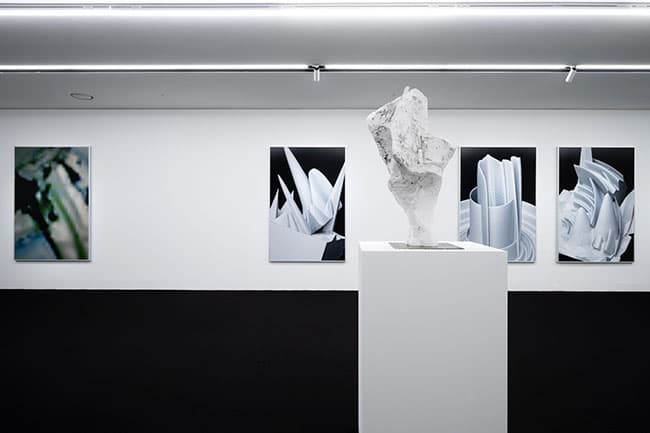
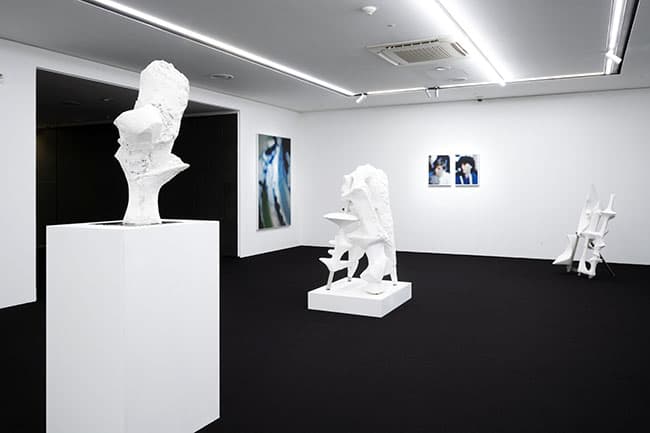
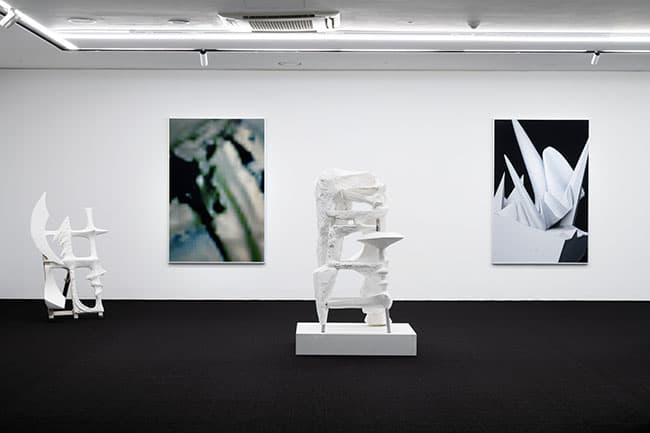
▲Hong Kiha regards the act of producing and exhibiting large, heavy sculptures today as a kind of resistance, and seeks to pursue the value unique to sculpture despite the environmental difficulties. He clings to a degree to the inefficient materials, weight, and production methods of traditional sculpture, searching within them for contemporary possibilities. The works by Hong Kiha shown here are all plaster sculptures—not reproducible editions, but singular pieces each made through a weaving method. They embody reflections on materiality and existence that unfold all the more deeply precisely because virtual space exists.
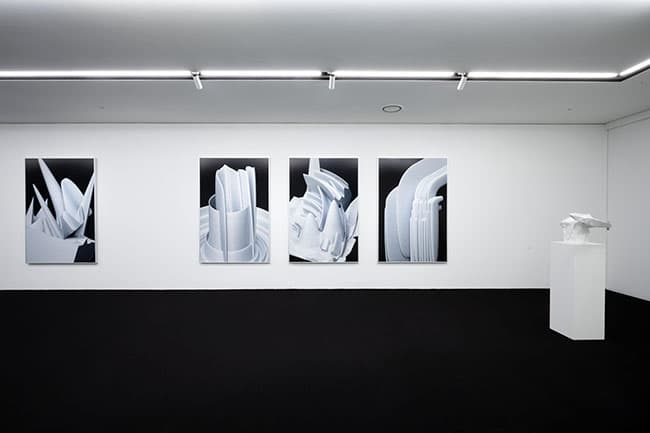
▲Jung Youngho has produced work that explores ‘digital materiality,’ bringing to the surface of his photographs the RGB pixels of a screen or the textures of 3D-printed objects. In his recent work, the original raw material is the words that collide within the public sphere of the internet. The artist utilizes big data on the ‘keyword mention volume’ of politically charged and sensitive terms, going through a process of giving form to the flow of data. This data graphic is output as a 3D-printed object and then photographed once again. Resembling computer graphics, Jung Youngho’s photographs are, in the end, images of actual objects captured in real space. In a single photograph that flatly compresses a complex working process, the fragments of data appearing on the surface are difficult to grasp as clear information. This strategy of ambiguity is a result of being conscious of the situation of standing in the material world while looking out at the world of data, and it reveals the opacity of indirect experience.
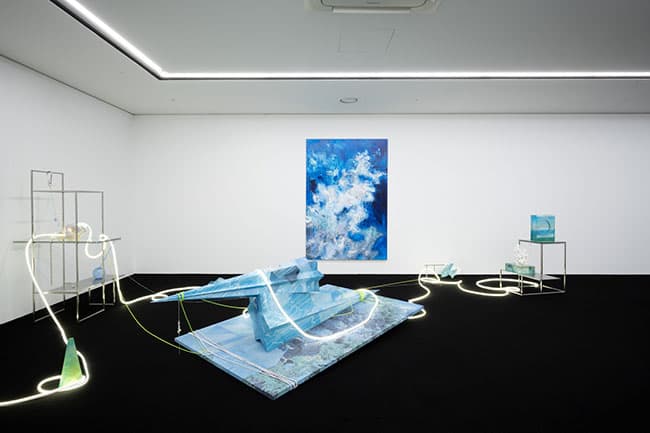
▲Heo Yeonhwa develops work that draws landscapes within space through multimedia installation. She is particularly interested in work that compresses and presents space-time that is vast in scale or exists across diverse strata, moving between the two-dimensional and the three-dimensional, between data and matter in the process. This working method emerged as the artist joined the finitude of physical space—which she felt firsthand when she first began making sculpture—with the infinite nature of virtual space. Polyhedra and creased planes holding multiple, differing images of space are examples of this. Heo Yeonhwa also focuses on water—a substance that flows without boundaries in real space—exploring its transparent, cascading materiality and the sense of connection.
The artists taking part in this exhibition explore a single medium, sculpture (Hong Kiha); create outcomes that, through an intricate and multilayered process, converge into a single photograph (Jung Youngho); or search for their own language by traversing between the two-dimensional and three-dimensional, the virtual and the material (Heo Yeonhwa). In their work, the correlation between medium and creation cannot be explained solely by the differences among surfaces made of different materials. What is more worth noting is each artist’s way of responding to today’s media environment, in which the digital and material worlds coexist and influence one another. Though their specific materialities differ, what matters to all three artists is materiality (rather than virtuality), and one can glimpse their processes of seeking to renew a sense of the ‘matter’ that still forms the foundation of art. 070-4676-7096