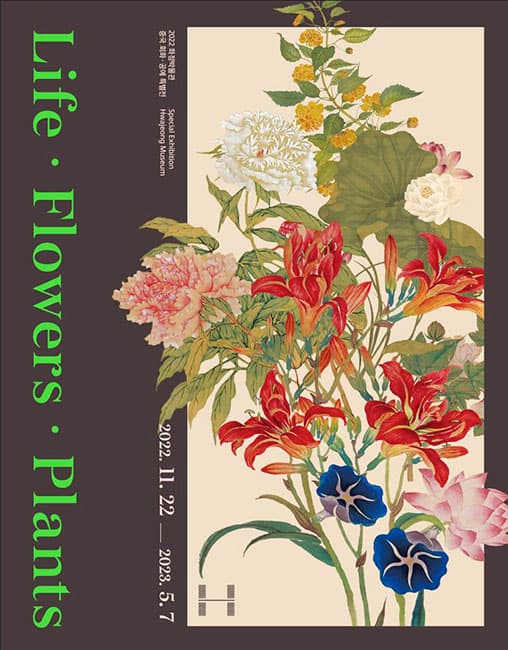
Special exhibition of Chinese paintings and crafts from the museum collection, on view through May 7
The oldest and most universally beloved subject across the world
The Hwajeong Museum is presenting the special exhibition 'Life·Flowers·Plants' through May 7 of this year.
Featuring some 100 paintings and craft works, the 'Life·Flowers·Plants' exhibition is organized around works depicting flowers and trees selected from among the representative Chinese Qing-dynasty paintings and crafts in the Hwajeong Museum's collection. The theme of 'plants,' including 'flowers' and 'trees,' has been one of the oldest subjects in art since ancient times. It has been applied broadly across everyday life and artistic culture as a whole.
This exhibition looks at the museum's Chinese art collection in two ways: △ examining a variety of works that depict flowers and trees following the flow of the four seasons, in the order of autumn-winter, spring, and summer, and △ exploring, among the countless flowers and trees, the intentions behind choosing to depict particular flowers and trees and the symbolism hidden within them.
Among the countless flowers and trees, those that were especially favored and treated as subjects of art carry meanings shared within society and culture, and they also express what that era and culture aspired to.
Images of flowers, trees, and plants are beautiful in themselves and pleasing to look at, and they adorn a space beautifully. At the same time, because flowers, trees, and plants rendered throughout painting and craft can be kept close at hand and appreciated at any time regardless of the season, from the very moment they chose a particular plant as a subject for painting or craft, people of the past pursued something more than simply transferring nature as it is. This reflected a heart wishing for a stable and abundant life—longevity, the prospering of descendants, and worldly success—while at the same time carrying meanings of realizing various ideal values such as fidelity, integrity, and incorruptibility. This enriched and diversified life and culture, and it was continuously and widely employed over a long period of time.
Above all, images of plants such as flowers and trees can be said to be the oldest and most universally beloved subject across the world, from traditional societies to the present day. In this sense, we hope this exhibition can offer the roots of a culture that continues from ancient times to today—or another perspective from which to examine it.
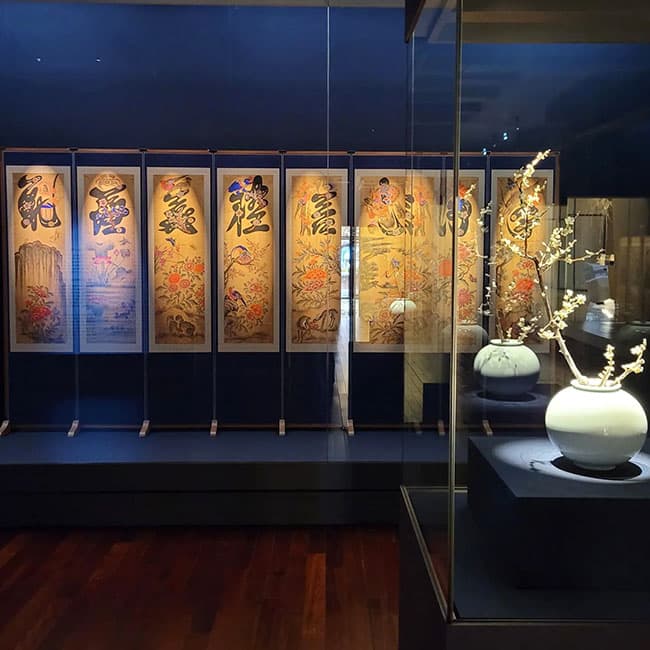
Alongside this special exhibition, Gallery 1 of the Hwajeong Museum is also displaying 11 Joseon-dynasty 'minhwa' (folk painting) folding screens from the museum's collection. These include works on familiar themes that can be appreciated together with the Life·Flowers·Plants exhibition, such as flower-and-bird paintings (hwajodo), ideograph paintings (munjado), scholar's-accoutrement paintings (munbangdo), and Romance of the Three Kingdoms paintings (samgukjido). In addition, the museum's eight-panel folding screen 'Chilbosando (七寶山圖)' is being unveiled for the first time. The 'Minhwa: Folding Screens' exhibition runs through June 4, 2023.
The Hwajeong Museum was founded on the wish to share cultural heritage with many people, based on the diverse East Asian artworks collected over more than 40 years by its founder, the late Dr. Han Kwang-ho (art name Hwajeong). Carrying on that vision, the Hwajeong Museum fulfills its distinctive role as a museum through activities such as collecting, researching, exhibiting, and providing education on cultural heritage, and among its diverse East Asian holdings, its 'thangka' collection is regarded as one of the finest in the world.