
Analysis based on 27 representative home appliances shows a 10% decline compared to 2021
Consumer spending contracts as the COVID-driven boom fades amid an economic downturn
According to global market intelligence firm GfK, the home appliance market, which recorded strong growth during the COVID-19 period, peaked in 2021 and then declined 10% in 2022. This analysis is based on 27 representative home appliances in Korea and covers major offline and online channels (based on sales revenue).
Having posted exceptional growth in 2020 and 2021 due to COVID-19, the home appliance market saw negative growth from 2022 as a base effect took hold, with the COVID-driven boom fading alongside the shift to endemic conditions. On top of this, high prices—triggered by the prolonged pandemic and the Russia-Ukraine war—increased the burden of household spending and heightened expectations of an economic slowdown. The rapidly cooling consumer sentiment that resulted further contracted the market for home appliances, which are durable goods highly sensitive to economic conditions.
In particular, the market, which had shown a relatively moderate decline of -5% in the first half, fell more sharply in the second half of 2022, when benchmark interest rates rose steeply in earnest due to inflation and the real impact of inflation began to pressure end consumers across the board. In the second half of 2022, the growth rate registered -16% (compared to the second half of 2021). The decline is analyzed to have widened further as retailers significantly scaled back their year-end mega-discount events, both because of inflation and out of respect for the mourning atmosphere following the Itaewon tragedy.
By product category, every category (IT, major appliances, consumer electronics, and kitchen appliances) posted negative growth compared to 2021, with the exception of cameras/imaging, whose market recovered as conditions became endemic. Among these, the category with the largest decline was major appliances, which fell 15% compared to 2021. Even among home appliances, major appliances have a high unit price and a long replacement cycle; the fact that replacement demand had been pulled forward during the COVID-19 period through revenge spending and the like is analyzed to have widened the decline. In addition, the drop in home sales and moves due to the worsening real estate market also served as a factor pushing down demand for major appliances.
The overall decline in the home appliance market even lowered the growth rate of online channels (open markets, social commerce, general malls, and TV home shopping), which had been growing steadily. In 2022, the growth rate of online channels (compared to 2021, based on sales revenue) was -3%, while sales growth in offline channels (home appliance specialty stores, large discount stores, and department stores) recorded -16%, declining together. However, in line with the consumer trend of steadily shifting to online, online channels recorded a relatively lower decline rate than offline channels. As a result, the share of online channels in the overall market rose to 45.9%, up 3.4 percentage points from 2021.
Shin Hye-mi, a researcher at GfK's Retail Services Team, said, “With the shift to endemic conditions and reduced consumption due to inflation and economic uncertainty, the home appliance market recorded a substantial decline in 2022. Compared to 2019, however, the market still remains 5% larger than it was before COVID-19. This is because, even amid the overall decline, there are products and brands that maintain the market by seizing new opportunities from the changed consumer needs and lifestyles that emerged after COVID-19.” She added, “If high prices continue at their current level in 2023 as well, it would be difficult to expect a market rebound. But there are categories—such as kitchen appliances—that can benefit as an indirect result of high prices, and by targeting higher-income consumer segments that are less affected by high prices, brands will still have opportunities to deliver results.”
Meanwhile, over a period of more than 85 years, GfK has earned the trust of customers worldwide by supporting them in their business decision-making processes regarding consumers, markets, brands, and media. GfK's reliable data and insights, together with advanced artificial intelligence (AI) capabilities, are revolutionizing how it provides essential insights that give customers and partners real-time access to actionable recommendations for the efficiency of their marketing, sales, and organizations—thereby delivering Growth from Knowledge to customers.
▲ Growth rate of Korea's home appliance market in 2022
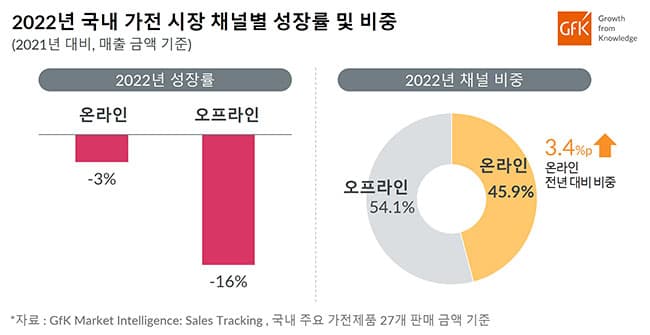
▲ Growth rate and share by channel of Korea's home appliance market in 2022