
The summer of 2018 not only recorded the highest temperatures since weather observation began, but also broke all-time records for the nationwide average high temperature and the number of heat-wave days since 1973. In Seoul, daily high temperatures exceeded 30 degrees for a remarkable 42 days from July 13 to August 23, and on August 1 the city recorded 39.6 degrees, the highest in 111 years. This was more than about 5 degrees above the typical seasonal temperature. This year, too, high-temperature conditions have already appeared as early as May, raising the question of whether Korea should now be considered part of a tropical climate zone like the Middle East or North Africa.
Such intense heat is hard not only on people but also on air conditioners. A heat-pump air conditioner works on the principle of drawing energy (heat) out of a hot interior and releasing that energy to an even hotter exterior; the higher the outdoor temperature, the more the cooling capacity (the ability to draw heat out of the interior) declines. The hotter it gets, the greater the cooling capacity required—yet in practice the unit becomes unable to cool the indoor air.
To solve this problem, Samsung Electronics has unveiled the ‘DVM S High-Temperature Model,’ a first in Korea, capable of delivering higher performance than conventional system air conditioners under high outdoor-temperature conditions. Samsung Electronics’ DVM S High-Temperature Model delivers 100% of its rated performance even at an outdoor temperature of 43 degrees—higher than the 39.6-degree peak recorded in Seoul in 2018—and can cool continuously even at up to 50 degrees without the outdoor unit shutting down. As a result, it can operate continuously and deliver optimal performance even in enclosed machine-room spaces where, depending on the building’s installation environment, installation would otherwise be impossible or performance would inevitably drop significantly.
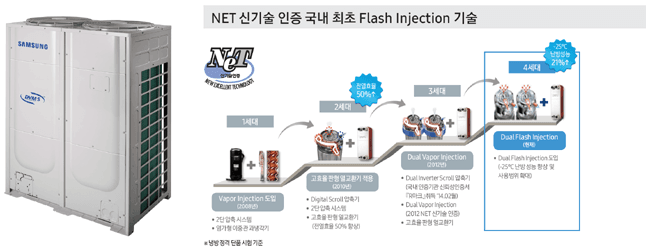
Samsung Electronics was able to introduce such a product on the strength of more than 20 years of accumulated system air conditioner technology and its 4th-generation Dual Flash Injection compressor technology. In particular, drawing on its experience of continuously supplying system air conditioners to tropical climate zones such as the Middle East and North Africa, the company planned and launched this product based on its judgment that a high-temperature model is now needed in Korea as well.
Samsung Electronics’ DVM S High-Temperature Model proves its worth not only in intense heat. The technologies applied to secure cooling capacity at high temperatures also prove their worth during heating in the cold of winter. It is no exaggeration to say that the 4th-generation Dual Flash Injection technology was in fact developed first for heating at low temperatures rather than for cooling at high temperatures. This technology can deliver 90% of rated heating capacity (based on 14 horsepower) even at an outdoor temperature of minus 15 degrees, and also enables warm heating operation even under the extreme conditions of minus 25 degrees.
In addition, to resolve the perceived heating deficiency during defrost operation—which consumers cite as the most inconvenient aspect of winter heating with a heat-pump air conditioner—the model newly applies learning-based defrost operation, which has received Korea’s New Excellent Technology (NET) certification. Defrost operation refers to the process of periodically halting heating operation and melting away the ice that forms when moisture in the air freezes onto the cold outdoor heat exchanger during winter heating, thereby reducing the heat exchanger’s efficiency; because heating stops during this process, consumers perceive it as a source of dissatisfaction.
Dissatisfaction with the perceived heating performance caused by defrost operation had long remained an unsolved challenge for heat-pump-type air conditioners and heaters, but Samsung Electronics resolved the problem—and was able to greatly ease actual perceived dissatisfaction—through new technology that learns and optimizes the frost-formation and defrosting processes.
Such high-performance products demonstrate their capabilities not only under abnormal conditions of extreme heat or extreme cold. The compressor and heat exchanger design technologies used to secure performance at extreme high and low temperatures can also reduce operating costs through enormous efficiency improvements under ordinary operating conditions and very low part-load operating conditions. Naturally, every model is a top-efficiency product with a Grade 1 energy efficiency rating.
Going forward, Samsung Electronics plans to continue enhancing the customer trust it has built up so far and the reputation of its product brand by introducing a variety of site-tailored products in response not only to changes in Korea’s climate conditions but also to consumers’ living environments and lifestyle patterns.