
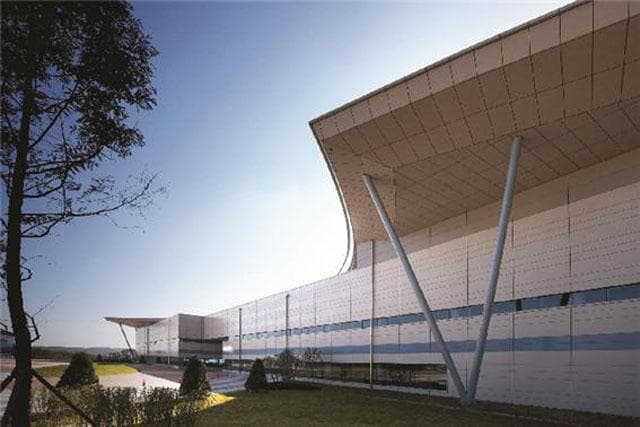
SY announced that it is expanding its lineup of high-performance fire-resistant sandwich panels in order to lead the fire-resistant building materials market. A fire-resistant sandwich panel is a composite material certified for its ability to withstand fire and block flames for 30 minutes or more without burning. Under the Building Act, a material is certified as non-combustible if, when heated for 20 minutes, it emits no harmful gases and generates no heat of its own — and these panels meet an even higher standard.
Products can only be distributed on the market after passing the stringent certification standards of the Korea Institute of Civil Engineering and Building Technology. Thanks to their excellent fire safety, they are also used as fire compartments in large buildings of 1,000㎡ or more. Among them, the 'No-Rivet Fire-Resistant Panel,' launched this year, has been well received in the field for maximizing installation convenience through its patented technology. Its key feature is that it maintains fire-resistance performance without the dense rivet (nail) installation normally required for the airtight construction that prevents fire from leaking through.
In the field, even fire-resistant installation methods are subject to monitoring by the Ministry of Land, Infrastructure and Transport, so ease of installation is an important consideration. The company said that because cumbersome construction steps can be omitted, installation time is cut to about half of the conventional level and construction costs are reduced by around 20%.
The 'Hidden Metal 2' is also undergoing one-hour fire-resistance certification. It features round-finished edges on all four sides without bending, and by reinforcing the joints
and the entire span it improves waterproofing and durability, having been applied mainly to semiconductor plants and similar facilities. When a fire-resistant sandwich panel is used on an exterior wall, insurance premiums are discounted by about 40% compared to using a non-combustible material. On the basis of a 10 billion won insurance policy, the annual premium savings alone amount to around 20 million won. Depending on the scale of the project, the increase in material costs is offset by the premium savings within 5 to 10 years.
An SY official said, “After the Icheon fire, as institutional changes are being pursued to make the use of semi-non-combustible sandwich panels mandatory instead of cheap combustible ones, the sandwich panel market is expected to move upmarket, competing on quality rather than price,”
adding, “Since one-hour fire-resistance-certified panels secure both safety and economic efficiency when used on building exterior walls, SY will expand the market itself with premium products that add functionality.” 1588-0680