
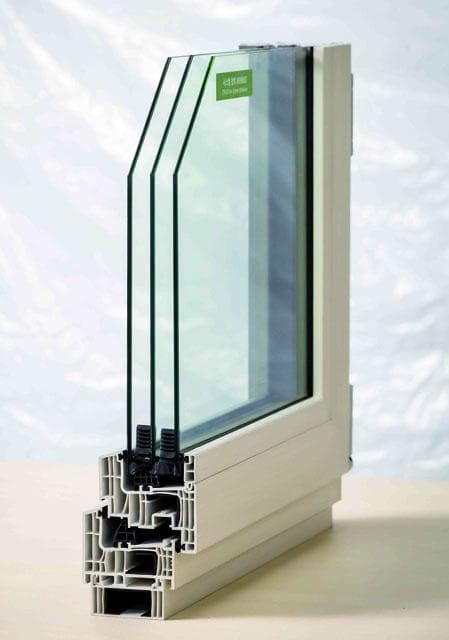
‘MBR88Z’, the passive house window unveiled by KCC, is a Tilt & Turn system window that satisfies both insulation and convenience at the same time. In particular, it is the first product in Korea to earn the PH (Passive House) Z1 grade from the Passive Zero-Energy Architecture Research Institute, with its outstanding insulation performance standing out.
In addition, the ‘MBR88Z’ is characterized by maximized insulation performance achieved through a wide frame, a multi-chamber structure, and triple air-sealing. On top of this, high-performance Low-E triple glazing is applied to firmly contain the energy leaking to the outside. It can be opened and closed in two ways—the tilt method, in which the window tilts forward to open, and the turn method, in which the entire window swings wide open inward—making ventilation control convenient as well.
On July 15, KCC took part in the 2020 Korea Mechanical Facilities Exhibition held at SETEC in Hangnyeoul, presenting passive house windows applied to zero-energy buildings at the Korea Land & Housing Corporation (LH) exhibition hall. LH set up a promotional hall and introduced KCC windows as a ‘recommended material suitable for zero-energy construction.’
The fact that LH—which is actively pursuing the zero-energy construction business—selected KCC products as excellent window materials at this exhibition also means that KCC windows have once again been recognized for their performance as a standard model suitable for zero-energy buildings.
A zero-energy building refers to a building that minimizes energy demand by applying ‘passive’ technology, which maximizes insulation performance to reduce heating and cooling energy use, and ‘active’ technology, which produces renewable energy such as solar and geothermal power. Since a significant portion of a building’s energy loss occurs at the windows, the importance of high-insulation windows is bound to be further highlighted.
Amid the government’s recent acceleration of the ‘Green New Deal,’ the zero-energy construction market—a related business field—is gaining momentum. Earlier, at the beginning of this year, the government announced that it would phase in the mandatory adoption of ‘zero-energy construction’ for all buildings by 2030, starting with public buildings of 1,000㎡ or larger. As the zero-energy construction market is expected to expand going forward, interest in high-efficiency building material products, including KCC windows, is expected to grow.
A KCC official said, “Because meeting the passive elements of zero-energy construction inevitably requires the application of high-efficiency materials, the era of mandatory zero-energy construction carries no small significance for the window and building materials industry,” adding, “We will take the lead in developing high-efficiency products equipped with both insulation and functionality so that we can contribute to invigorating zero-energy construction.” 02-3480-5000