
PAKO, an agricultural corporation, creates income by utilizing idle farmland
Building a new ‘agricultural timber’ business model with ultra-fast-growing paulownia trees
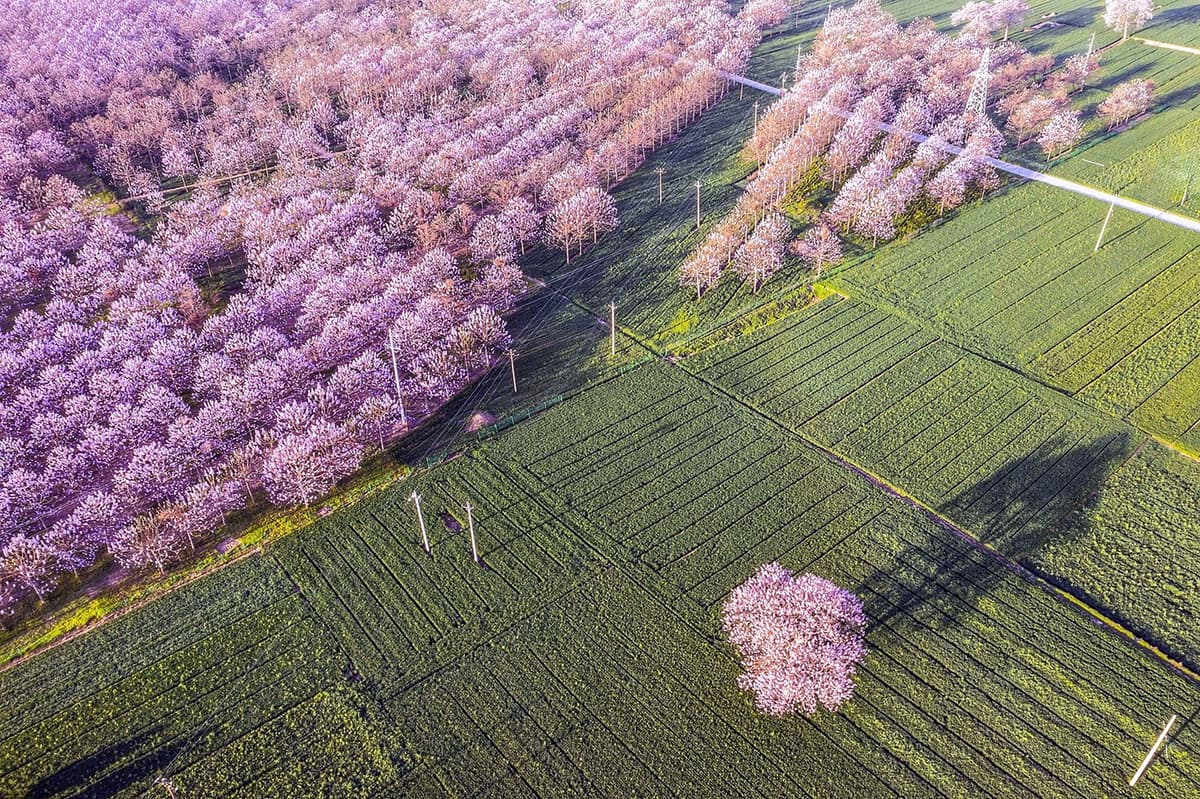
PAKO, an agricultural corporation established with investment from KDWOODTECH, a company specializing in interior and exterior building materials, is now moving full speed ahead with its ‘Super Paulownia’ afforestation project. The company plans to convert idle farmland into a high-income resource while simultaneously pursuing carbon neutrality and timber self-sufficiency, and to address the problem of regional decline by championing a new ‘agricultural timber’ model.
PAKO designed its business model with a focus on paulownia, a tree known for its rapid growth and outstanding regenerative capacity. Its key advantages are that it requires management only for the initial six months and virtually no special care thereafter, can be harvested on a six-to-eight-year cycle, and regenerates through coppicing without the need for replanting. From the third year, the trees begin to bloom, allowing income sources to be diversified into honey (nectar) production, landscaping, and tourism resources, making it possible for farming households to design a mid- to long-term revenue structure. PAKO has established a one-stop system that covers everything from seedling supply and afforestation consulting to harvesting, processing, and distribution, giving it a stable business model. Over the long term, the company aims to develop nationwide afforestation complexes and processing clusters to build an ‘agricultural timber’ industry foundation in which timber production, processing, and distribution all take place in one place. Pilot afforestation is currently under way in areas such as Pocheon in Gyeonggi Province, Jecheon in North Chungcheong Province, Hongcheon in Gangwon Province, and parts of South and North Jeolla Provinces, where test complexes on idle farmland are showing favorable growth. In 2026, concrete business results are becoming visible—including the development of afforestation farmland in cooperation with local governments, seedling supply to private farming households, and the establishment of distribution networks—and these are being assessed as cases that prove the feasibility of the ‘agricultural timber’ model PAKO has proposed. The ‘Super Paulownia’ supplied by PAKO can be planted at a density of about 400 to 800 trees per hectare (ha) and is an ultra-fast-growing species that reaches a diameter at breast height of around 40 cm within six to eight years. Through this, the company presents a new turning point for the domestic market, which is heavily dependent on timber imports, with a strategy that simultaneously achieves the high value-added use of idle farmland, the securing of emission rights through carbon absorption, and an improved self-sufficiency rate for domestic timber. The company intends to establish paulownia afforestation as a Korean-style carbon-neutral model by creating a virtuous cycle of timber self-sufficiency and the regional economy.
KDWOODTECH holds a wide range of high-performance timber product lines whose technological capabilities have been recognized both at home and abroad—including compressed wood, carbonized wood, chemically modified wood, acoustic wood, and end-grain flooring—and has in particular produced a variety of building materials using paulownia. Building on the material development and processing technologies it has accumulated over the years, the company plans to strengthen synergies with PAKO’s paulownia afforestation project.
Hong Tak, CEO of KDWOODTECH, said, “Complementing the weaknesses of timber with technology and enhancing its value through design is KDWOODTECH’s philosophy,” adding, “This paulownia project is a mid- to long-term endeavor to connect the timber industry with agriculture and create a sustainable regional industrial ecosystem.” He went on to emphasize, “Our goal is to build a structure in which idle land is used to absorb carbon while farming households and companies generate profits together.”
▲ PAKO, an agricultural corporation established with investment from KDWOODTECH, is moving full speed ahead with its ‘Super Paulownia’ afforestation project. The photo shows paulownia trees in bloom (Henan Province, China).